

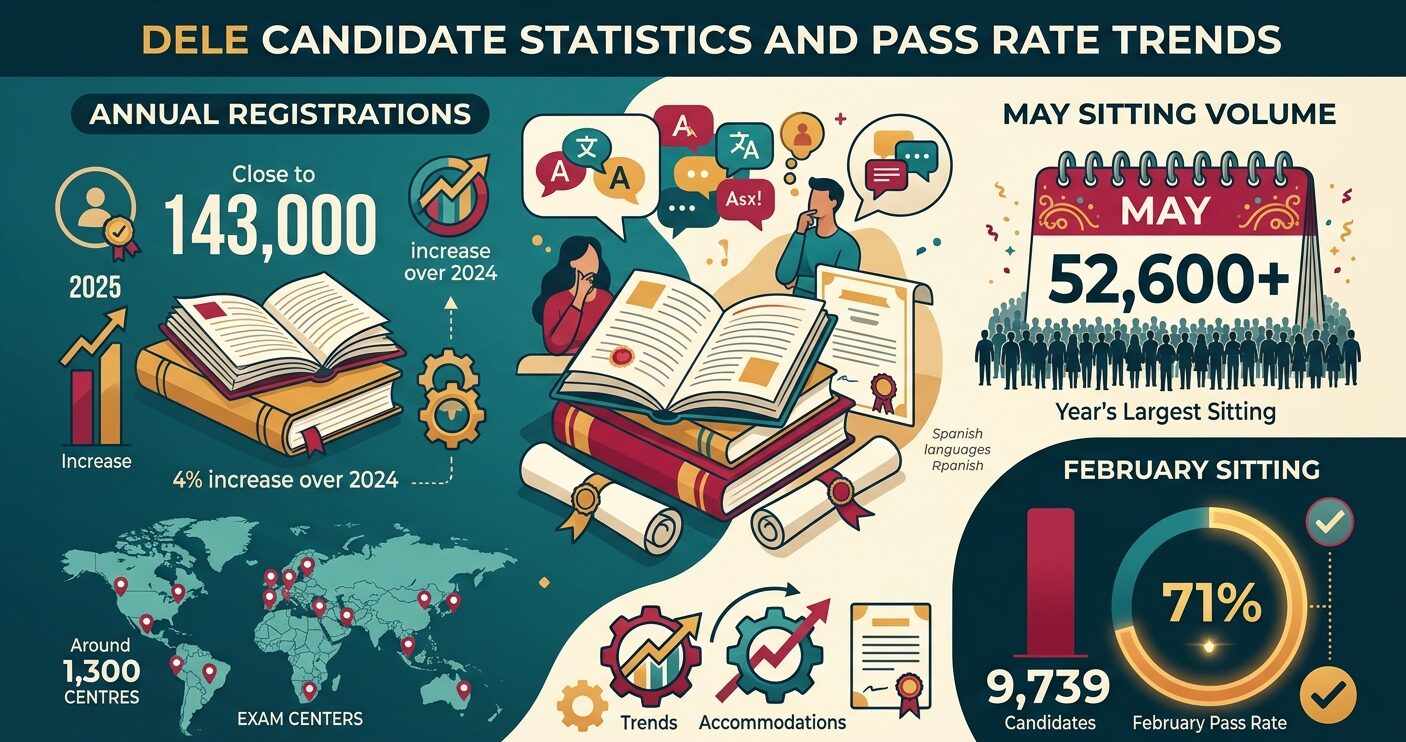
Close to 143,000 candidates registered for DELE exams in 2025, according to the Instituto Cervantes. The first 2026 sitting followed in February with 9,739 candidates and a 71% pass rate.
This set of DELE candidate statistics covers annual totals, registrations and pass rates per sitting, the 2026 and 2027 calendars, the exam-centre network, CCSE comparisons and accessibility requests.
DELE Candidate Statistics
How Many People Take the DELE Each Year?
Close to 143,000 people registered for a DELE exam in 2025, about 4% more than in 2024, per the Instituto Cervantes.
Growth slowed each year from 2023 to 2025. Cervantes reported a rise of 11% for 2023 and about 9% for 2024.
| Year | Registered DELE candidates | Published year-on-year change |
|---|---|---|
| 2023 | More than 132,000 | 11% |
| 2024 | More than 137,000 | About 9% |
| 2025 | Close to 143,000 | About 4% |
Source: Instituto Cervantes, November press releases for 2023, 2024 and 2025
These totals count exam registrations across all levels and sittings. They are a different measure from the worldwide learner counts for Spanish and other languages.
Candidates per DELE Sitting, February 2025 to February 2026
May 2025 drew more than 52,600 registrations. November followed with 33,944, and Cervantes ranks November second by volume, behind May.
September 2025, an A2-only date, posted the smallest published count at more than 7,500.
| Sitting | Registered candidates | Of which A2-NA |
|---|---|---|
| February 2025 | About 9,600 | More than 1,500 |
| April 2025 | About 15,000 | More than 1,150 |
| May 2025 | More than 52,600 | 1,238 |
| July 2025 | More than 14,200 | 1,067 |
| September 2025 | More than 7,500 | More than 1,267 |
| October 2025 | More than 10,000 | More than 1,000 |
| November 2025 | 33,944 | 1,527 |
| February 2026 | 9,739 | 1,689 |
Source: Instituto Cervantes, DELE results notices, February 2025 to February 2026 sittings
Non-Literate A2-NA Candidates
The adapted A2 exam for candidates who cannot read or write drew 1,689 registrations in February 2026. The February 2025 notice reported more than 1,500.
Each 2025 sitting reported at least 1,000 A2-NA candidates. Since December 2024, registration checks each candidate’s literacy exemption against their NIE, according to the Cervantes 2024–2025 annual report.
Registration counts measure exam demand, not preparation time; FSI hours-to-fluency rankings cover that side.
What Is the DELE Pass Rate in 2026?
The February 2026 sitting passed 71% of candidates across the A2 and A2-NA exams combined. It is the latest sitting with a published pass rate.
Each figure below is the overall pass rate for its sitting. May, July, October and November also examined higher levels, so those rates are not A2-only.
| Sitting | Overall pass rate | Exams in the sitting |
|---|---|---|
| February 2025 | Around 70% | A2, A2-NA |
| April 2025 | Around 70% | A2, A2-NA |
| May 2025 | Around 74% | A1–C2, school A1 and A2/B1 |
| July 2025 | 75% | A2, B1, B2, C1 |
| September 2025 | 73% | A2, A2-NA |
| October 2025 | 73% | A2, B1, B2, C1 |
| November 2025 | 75% | All general levels |
| February 2026 | 71% | A2, A2-NA |
Source: Instituto Cervantes, DELE results notices, February 2025 to February 2026 sittings
A2-only sittings ranged from around 70% in February and April 2025 to 73% in September 2025. French exam takers can set this against DELF pass rates by level.
Five DELE Sittings in 2026, Seven in 2027
Cervantes cut 2026 to five sittings and called the absence of July and September an exception. The published 2027 calendar restores seven dates.
| 2026 sitting | Written exam | Registration closes | Exams offered |
|---|---|---|---|
| February | 13 Feb | 7 Jan | A2, A2-NA |
| April | 17 Apr | 25 Feb | A2, A2-NA (Spain only) |
| May | 22–23 May | 8 Apr | School A1, A2/B1, B2/C1; general A1–C2, A2-NA |
| October | 16–17 Oct | 2 Sep | B1, B2, C1; A2, A2-NA |
| November | 13–14 Nov | 30 Sep | School A1, A2/B1, B2/C1; general A1–C2, A2-NA |
Source: Instituto Cervantes, DELE exam calendar, checked September 2026
The 2027 dates are 12 February, 2 April, 21–22 May, 9 July, 10 September, 15 October and 12–13 November. April 2027 offers A1, A2, B1, B2 and C1, where April 2026 offered A2 only.
Registration for 2027 opens on 18 November. Candidates budgeting for exams can compare language certification costs in the US.
The new DELE B2/C1 for school candidates debuted in May 2026. Cervantes had published all May 2026 general results by 7 September, with school results scheduled from 8 to 13 September.
Reviews also changed. Each candidate now has 30 days from receiving their certificate email to buy a grade review, replacing a single review window.
DELE Exam Centres by Country and City
| November sitting | Candidates | Countries | Exam centres | Cities |
|---|---|---|---|---|
| 2023 | More than 31,000 | 93 | 558 | 420 |
| 2024 | More than 33,000 | 107 | 584 | 440 |
| 2025 | Close to 34,000 | 95 | 596 | 432 |
Source: Instituto Cervantes, November press releases, 2023–2025 (pre-sitting figures)
November 2025 ran in 596 centres, up from 584 a year earlier. Participating countries fell from 107 to 95 over the same period.
The full DELE network is larger than any single sitting. Cervantes reports around 1,300 centres in 120 countries and more than 800 cities in its 2024–2025 annual report, up from more than 1,200 centres in 2023–2024.
These releases do not break 2025 candidates down by country. For US demand context, see Spanish speakers by US state.
How DELE A2 Candidate Numbers Compare With CCSE
Spanish nationality by residence requires a DELE A2 or higher plus the CCSE civics test, unless the applicant is exempt, per the Instituto Cervantes.
February 2026 is the cleanest comparison because that DELE sitting was A2-only.
| Exam, February 2026 | Registered candidates | Pass rate |
|---|---|---|
| DELE A2 and A2-NA | 9,739 | 71% |
| CCSE ordinary | 26,726 | More than 96% |
| CCSE-NA (adapted) | 1,044 | More than 67% |
Source: Instituto Cervantes, DELE and CCSE results notices, February 2026
Cervantes examined 277,222 CCSE candidates across 2025: 269,080 ordinary and 8,142 CCSE-NA.
The March 2026 ordinary CCSE drew 26,033 candidates, with more than 96% passing. CCSE-NA registered 907 and passed more than 67%.
Accessibility Requests Among DELE Candidates
DELE handled 1,021 accommodation requests in 2024–25, up from 925 in 2023–24, per the Cervantes annual reports.
Learning difficulties accounted for 764 of the 2024–25 requests. Motor disability followed with 93, then visual impairment with 84.
| Request type | 2023–24 | 2024–25 |
|---|---|---|
| Learning difficulties | 713 | 764 |
| Motor disability | 76 | 93 |
| Visual impairment | 78 | 84 |
| Hearing impairment | 65 | 76 |
| Internment | 0 | 4 |
| Total | 925 | 1,021 |
Source: Instituto Cervantes, Memoria 2023–2024 and Memoria 2024–2025, exams chapter (academic years)
Braille exams numbered 8 in 2024–25, against 9 a year earlier. Another 43 adaptations for blind candidates, including enlarged booklets and digital formats, were logged in 2024–25.
The CCSE recorded 202 accommodation requests in 2024–25, compared with 220 in 2023–24.
FAQs
How many people take the DELE exam each year?
Close to 143,000 candidates registered for DELE exams in 2025, about 4% more than the 137,000-plus recorded in 2024, according to the Instituto Cervantes.
What is the DELE A2 pass rate?
71% at the February 2026 sitting, which covered the A2 and A2-NA exams for 9,739 candidates. A2-only sittings in 2025 returned between around 70% and 73%.
Which DELE sitting has the most candidates?
May. The May 2025 sitting registered more than 52,600 candidates across all levels. November ranks second, with 33,944 registered in 2025, per Instituto Cervantes results notices.
Is the DELE A2 as hard as Reddit threads suggest?
Reddit posts are individual accounts. Official data shows 71% of the 9,739 candidates at the February 2026 A2 sitting passed, and no 2025 sitting fell below around 70%.
When are the next DELE exam dates?
The remaining 2026 sittings are 16–17 October and 13–14 November. November registration closes 30 September 2026. Seven sittings are scheduled for 2027, starting 12 February.
