

In the world of gaming, a heart usually means health. A gear suggests settings, and a map pin points toward a place.
Players understand those symbols before reading instructions. Trouble starts when the screen adds labels such as cooldown, multiplier, volatility, or Bonus Buy.
The words are visible, yet their function may remain unclear. One might name an action, another a measurement, and another a feature.
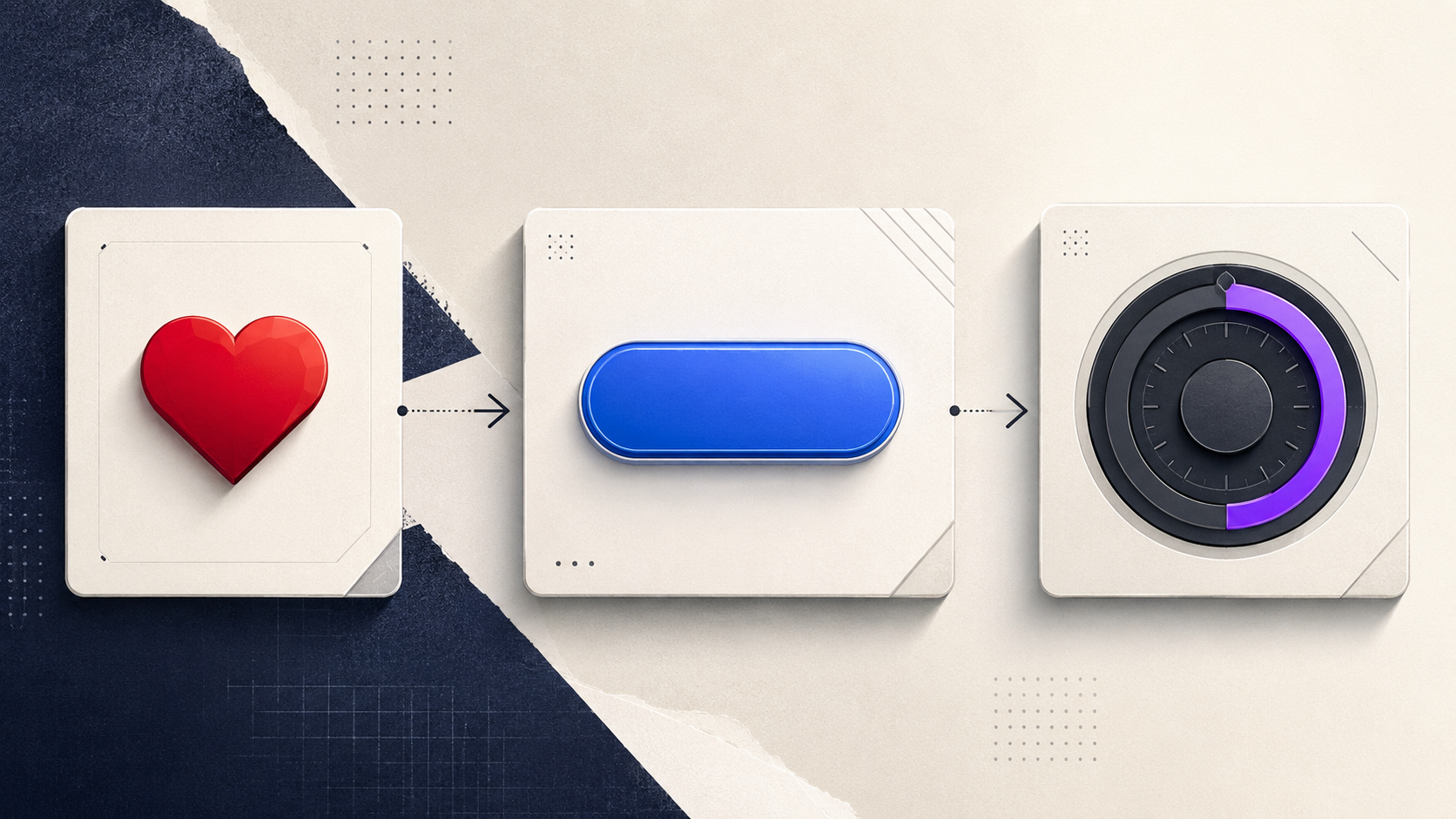
Language can influence what people notice. In a 2024 PLOS One visual-search study, 186 adults searched arrays of objects after receiving labels in different formats.
Responses were 39 milliseconds faster overall when a visual category label was paired with the spoken label rather than white noise.
The advantage varied by category, so a label is not an automatic shortcut. It works best when it gives the viewer an expectation of what they will find.
A Symbol Points, While a Label Narrows the Meaning
Icons handle quick recognition. Text handles distinctions. A speaker icon identifies sound controls, but nearby words separate music, dialogue, and effects.
A clock shape may represent time, yet a label tells the player whether it is a countdown, cooldown, or session timer.
Mechanic names carry a heavier burden because they may describe a sequence that cannot be understood from one image.
This page featuring slots games at an online casino shows how much work different labels are expected to do.
Headings such as New Slots, Low Volatility, High Volatility, Hold & Win, Bonus Buy, Table Games, and Video Poker sort titles by format or a broad playing characteristic. Terms such as wilds, scatters, multipliers, and free spins refer to elements within individual games.
Those groups should not be read in the same way. “Wild” identifies a symbol with a role defined by the chosen game, while “High Volatility” describes a mathematical pattern rather than an object on the reels.
“Bonus Buy” signals that direct access to a bonus feature is available in certain titles, but the label cannot explain the feature cost, the standard route to the round, or how RTP and volatility relate to it.
The page helps readers locate examples, while each title’s rules and information panel provide the detail needed to understand them.
A short Bonus Buy explainer shows why some mechanic names need movement as well as text. It follows the action from selecting the feature to accessing the bonus round through a fixed cost, then separates that access method from RTP and volatility.
Seeing the order of events prevents a common reading error: assuming every term near the same button describes the same thing.
Read the Action Word Before the Number
When a screen is unfamiliar, the verb usually gives the fastest clue. Buy, equip, hold, skip, claim, and upgrade tell the player what an input will do. The number beside the verb must then be interpreted according to that action. It might show a cost, quantity, duration, level, or remaining uses.
Consider the number 20. Beside a stopwatch, it may mean seconds. On an inventory item, it could show how many are held. Next to “x,” it may be a multiplier. Printed above a progress bar, it might represent a level or percentage. Reading the number first reveals its size while leaving its purpose uncertain.
Placement adds another clue. Text inside a button usually names an action. A word above several tiles tends to group the items beneath it.
A small label beside a gauge commonly names whatever the gauge measures. These patterns are not fixed laws, but they let players form a sensible first guess before opening a help panel or glossary.
Color should support the message rather than carry it alone. Red may signal low health in one title and an opposing team in another.
Green can mean available, selected, or restored. A clear icon or label keeps the message readable when colors change, the screen is crowded, or the player cannot easily distinguish the palette.
Looking at a page of casino slots is an excellent starting point because you’ll see lots of varied symbols and labels, but you’ll also want to examine how other games handle these challenges.
Repetition Turns Labels Into Shortcuts
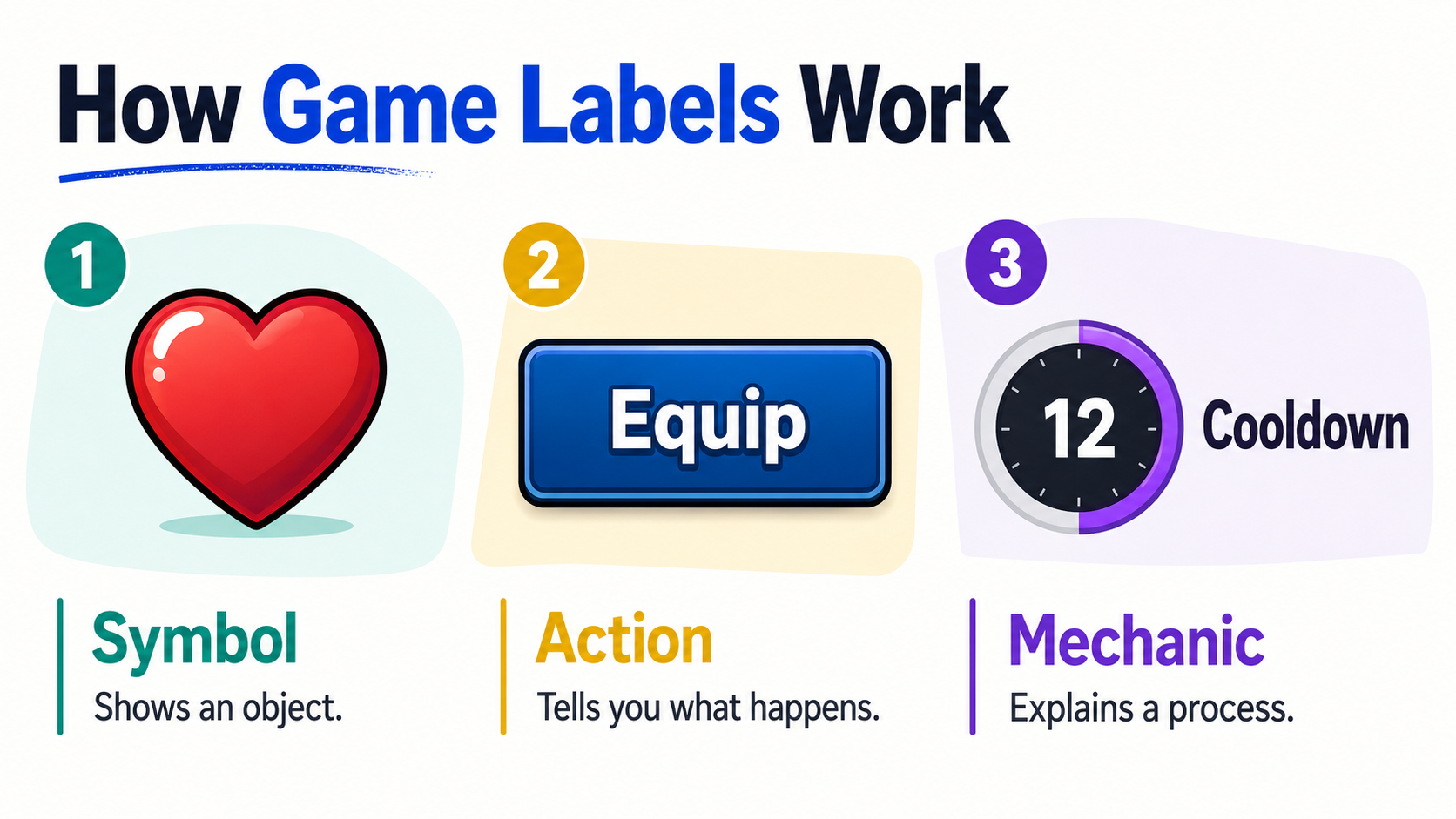
The first encounter with a mechanic may require a sentence, diagram, or demonstration. Later encounters need less explanation because the player has connected the term with an action and result.
“Cooldown” becomes useful shorthand after someone sees an ability become unavailable, watches the timer fall, and uses it again. The label then recalls the sequence.
Consistency makes that learning portable. If the same word appears on a button, tutorial, and information panel, the player can follow it across the screen.
Switching between near-synonyms such as store, shop, and market for one function creates needless doubt. Reusing one symbol for unrelated actions causes the same problem.
Words can also prepare the visual system for what follows. In an EEG experiment with 20 Dutch speakers, researchers found that the similarity between a cue word’s implied shape and the next pictured object predicted reaction times, with shape-related effects appearing early after the image arrived.
The small, controlled fruit-and-vegetable task should not be treated as a universal rule, but it helps explain why a familiar term can make a matching object easier to recognize.
A useful label gives the player a specific expectation, and then the screen confirms it through shape, position, and action.
