

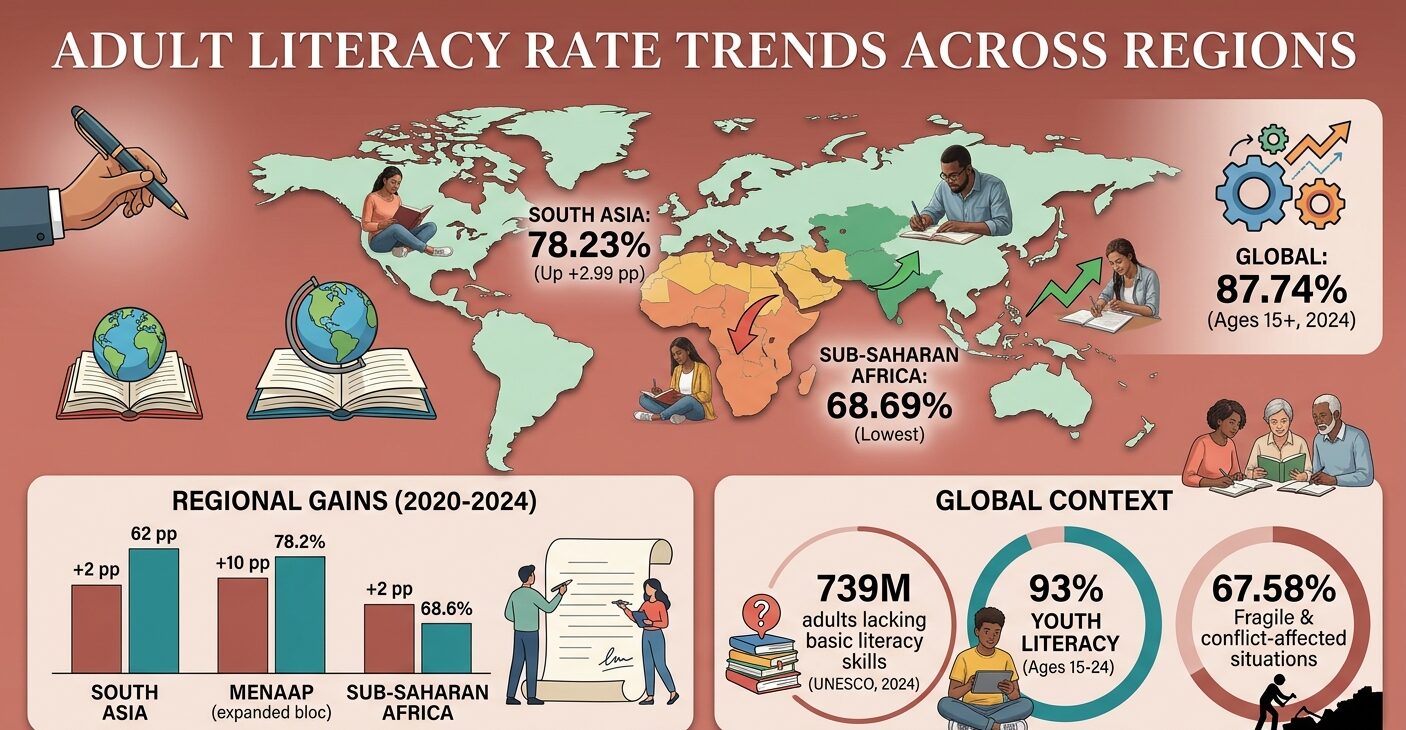
South Asia added 2.99 percentage points to its adult literacy rate between 2020 and 2024. Sub-Saharan Africa added 0.80 over the same years.
This guide tracks adult literacy rate trends across regions using the World Bank’s latest World Development Indicators, UNESCO’s 2024 count of adults without basic literacy, income-group splits, and the 2025 regrouping that moved Afghanistan and Pakistan out of South Asia.
Adult Literacy Rate Trends Across Regions
Which Regions Lead Adult Literacy Rate Trends From 2020 to 2024?
| Region (World Bank grouping) | 2020 | 2024 | Change (pp) |
|---|---|---|---|
| South Asia | 75.24% | 78.23% | +2.99 |
| Middle East, North Africa, Afghanistan & Pakistan | 73.45% | 75.59% | +2.14 |
| Sub-Saharan Africa | 67.89% | 68.69% | +0.80 |
| World | 86.98% | 87.74% | +0.76 |
| Latin America & Caribbean | 94.33% | 94.95% | +0.62 |
| East Asia & Pacific | 96.09% | 96.61% | +0.52 |
| Europe & Central Asia | 98.61% | 98.77% (2023) | +0.16 (2020–2023) |
Source: World Bank, World Development Indicators, adult literacy rate (% of people ages 15+), 2020–2024
South Asia posted the largest gain in the table, 2.99 points, reaching 78.23% in 2024. The Middle East, North Africa, Afghanistan and Pakistan bloc followed with 2.14 points.
Sub-Saharan Africa added 0.80 points, close to the world’s 0.76. Europe and Central Asia moved 0.16 points between 2020 and 2023, its latest year.
Sub-Saharan Africa is the only series in the chart that fell in a single year, from 67.89% in 2020 to 67.84% in 2021. The distance between South Asia and Sub-Saharan Africa widened from 7.35 points in 2020 to 9.54 points in 2024.
Source: World Bank, World Development Indicators, 2020–2024
A 27.9-Point Spread Splits Regional Adult Literacy in 2024
East Asia and Pacific recorded 96.61% in 2024. Latin America and the Caribbean recorded 94.95%.
Sub-Saharan Africa sat at 68.69%, 27.92 points below East Asia and Pacific. The latest Europe and Central Asia aggregate is for 2023, at 98.77%.
The World Bank counts a person as literate if they can read and write, with understanding, a short simple statement about everyday life. That is a lower bar than the fluency a reading accuracy calculator scores.
Source: World Bank, World Development Indicators, 2024 (Europe & Central Asia: 2023)
Why Did South Asia’s Literacy Series Change in 2025?
The World Bank’s metadata glossary states that, as of July 1, 2025 (FY26), Afghanistan and Pakistan are classified as part of the Middle East and North Africa region. The bank labels the expanded bloc MENAAP: Middle East, North Africa, Afghanistan and Pakistan.
South Asia now covers India, Bangladesh, Sri Lanka, Nepal, Bhutan and the Maldives. South Asia and Middle East literacy figures quoted from releases before the change may not match the current series.
Arabic is the main written language across much of the MENAAP bloc, and beginners can practice the script with these free Arabic worksheets.
Source: World Bank, regional classification for FY26 (effective July 1, 2025)
Long-Run Adult Literacy Rate Trends Across Regions, 1990–2024
The world adult literacy rate rose from 74.63% in 1990 to 87.74% in 2024. Between 2015 and 2024 it moved from 85.96% to 87.74%.
| Region | 1990 | 2000 | 2010 | 2024 |
|---|---|---|---|---|
| World | 74.63% | 81.12% | 84.37% | 87.74% |
| South Asia | 47.05% | 59.52% | 67.94% | 78.23% |
| Sub-Saharan Africa | 52.32% | 56.57% | 59.32% | 68.69% |
Source: World Bank, World Development Indicators, adult literacy rate, 1990–2024
South Asia Moved Above Sub-Saharan Africa in 1998
South Asia began 1990 at 47.05%, below Sub-Saharan Africa’s 52.32%. The South Asia series first moved above Sub-Saharan Africa in 1998, at 57.92% against 56.83%.
That order still held in 2024, at 78.23% versus 68.69%. Literacy is the base layer of attainment, and the top end is covered in tertiary education by country.
Source: World Bank, World Development Indicators, 1990–2024
Do Income Groups Follow the Same Adult Literacy Trend?
| Country group (World Bank) | 2020 | 2024 | Change (pp) |
|---|---|---|---|
| Upper middle income | 95.73% | 96.17% | +0.44 |
| Lower middle income | 76.04% | 78.28% | +2.24 |
| Low income | 61.88% | 63.57% | +1.69 |
| Fragile and conflict-affected situations | 67.11% | 67.58% | +0.47 |
Source: World Bank, World Development Indicators, adult literacy rate by country group, 2020–2024
Lower middle income countries gained 2.24 points, reaching 78.28% in 2024. Low income countries rose 1.69 points to 63.57%.
Upper middle income countries, already at 95.73% in 2020, added 0.44. Fragile and conflict-affected situations moved from 67.11% to 67.58% over the same four years.
Spending on digital learning is tracked separately in this online education market size breakdown.
UNESCO Counts 739 Million Youth and Adults Without Basic Literacy
At least 739 million youth and adults lacked basic literacy skills in 2024, according to UNESCO. About two-thirds of them are women.
Gender gaps in schooling more broadly appear in these male vs female education statistics.
UNESCO puts the global adult literacy rate at 88% in 2024, up from 86% in 2015. The World Bank’s unrounded 2024 figure is 87.74%.
Youth literacy, ages 15 to 24, reached 93% in 2024. UNESCO reports that six in ten adults without basic literacy live in two regions: Sub-Saharan Africa and Central and Southern Asia.
UNESCO’s 2025 International Literacy Day focused on literacy in the digital era. Investor activity in learning tools is tracked in EdTech venture funding statistics.
The 2026 International Literacy Day celebration ran on 8–9 September in Mexico, marking the day’s 60th anniversary. UNESCO’s headline count still refers to 2024.
Source: UNESCO, International Literacy Day 2025 data (2024 figures), as published by UN DESA
FAQs
Which region has the lowest adult literacy rate?
Sub-Saharan Africa, at 68.69% in 2024 according to World Bank data. That is 19.05 points below the world rate of 87.74%.
Which region has the highest adult literacy rate?
Europe and Central Asia, at 98.77% in 2023, its latest World Bank aggregate. East Asia and Pacific follows at 96.61% for 2024.
Is the global adult literacy rate still rising?
Yes. The World Bank series rose each year from 86.98% in 2020 to 87.74% in 2024. UNESCO reports 86% in 2015 and 88% in 2024.
How many adults cannot read worldwide?
At least 739 million youth and adults lacked basic literacy skills in 2024, according to UNESCO. About two-thirds of them are women.
Why do literacy rates by region on Reddit differ from World Bank figures?
Numbers vary by source, year and grouping. Since July 1, 2025, the World Bank places Afghanistan and Pakistan outside South Asia. Check the data year and regional definition before comparing posts.
Sources
https://data.worldbank.org/indicator/SE.ADT.LITR.ZS
https://fred.stlouisfed.org/series/SEADTLITRZSWLD
