

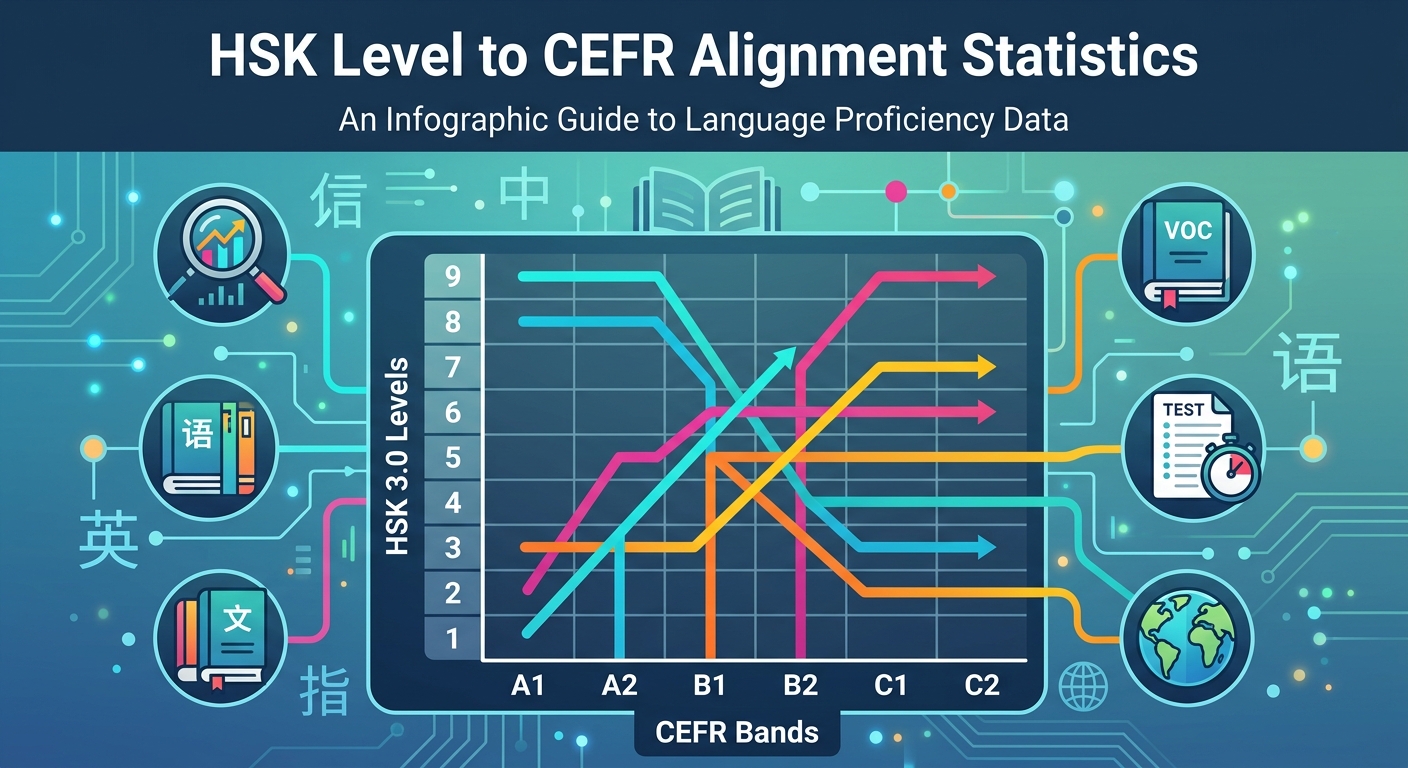
Four HSK 3.0 to CEFR alignment charts published between April and August 2026 agree on one level out of nine. Level 1 is A1 in all four. The other eight carry at least a one-band spread, and the test organiser has published no level-by-level equivalence of its own. This post compares those charts against each other and against the vocabulary, character and exam-format data they are built from.
HSK Level to CEFR Alignment Chart
What Does Each HSK Level to CEFR Alignment Chart Say?
ChineseLearner.com, Literate Chinese, Mandarin Zone and Linda Mandarin each publish a mapping. Only Level 1 draws the same single band from all four.
Level 5 splits hardest. ChineseLearner.com assigns C1 while the other three assign B2, which on an admissions form is the difference between advanced and upper intermediate.
Mandarin Zone sits a full band under ChineseLearner.com at Levels 2 through 5. Linda Mandarin publishes its table in reverse, from CEFR band to HSK range, and its rows straddle boundaries at Levels 2, 3 and 4.
| HSK 3.0 level | ChineseLearner | Literate Chinese | Mandarin Zone | Linda Mandarin |
|---|---|---|---|---|
| Level 1 | A1 | A1 | A1 | A1 |
| Level 2 | A2 | A2 | A1 | A1–A2 |
| Level 3 | B1 | B1 | A2 | A2–B1 |
| Level 4 | B2 | B1–B2 | B1 | B1–B2 |
| Level 5 | C1 | B2 | B2 | B2 |
| Level 6 | C1+ | B2–C1 | C1 | B2–C1 |
| Level 7 | C2 | C1–C2 | C2 | C1–C2 |
| Level 8 | C2+ | C1–C2 | C2 | C2 |
| Level 9 | C2+ | C1–C2 | C2 | C2 |
Source: ChineseLearner.com HSK 3.0 guide; Literate Chinese, July 2026; Mandarin Zone, updated August 2026; Linda Mandarin, August 2026, all accessed September 2026. Literate Chinese and Mandarin Zone publish one band for the whole 7–9 group. The Linda Mandarin column is its CEFR-to-HSK table read in reverse.
Literate Chinese states the limit plainly: Chinese officialdom describes the three stages as corresponding to the CEFR A, B and C bands but has issued no one-to-one table, so anyone giving an exact letter is interpolating, itself included. Exams built on the framework from the start, such as the French DELF and its level structure, carry no such gap.
Why Do HSK to CEFR Alignment Charts Disagree?
Two cumulative word lists are in circulation for the same nine levels. The 2021 Chinese Proficiency Grading Standards set Level 1 at 500 words. The exam syllabus released in November 2025 sets it at 300.
The two lists converge as levels rise. Level 6 sits at 5,456 words under the 2021 standard and 5,400 under the 2025 syllabus.
A chart weighted to the 2021 counts reads a mid-range level as more advanced than one built on the 2025 syllabus.
| Level | 2021 grading standard | November 2025 exam syllabus |
|---|---|---|
| Level 1 | 500 | 300 |
| Level 2 | 1,272 | 500 |
| Level 3 | 2,245 | 1,000 |
| Level 4 | 3,245 | 2,000 |
| Level 5 | 4,316 | 3,600 |
| Level 6 | 5,456 | 5,400 |
| Levels 7–9 | 11,092 | 11,000 |
Source: Mandarin Zone, New HSK 3.0 guide comparing the 2021 standard and the November 2025 syllabus, updated August 2026. Figures are cumulative words per level.
HSK 3.0 Character Requirements Behind the Alignment Chart
The November 2025 syllabus splits recognition characters from writing characters at every level. Recognition runs from 246 at Level 1 to 3,109 across Levels 7 to 9.
Writing lags throughout. Levels 1 and 2 share a combined list of 101 characters, and the 7–9 band asks for 1,208.
CEFR bands carry no equivalent split between receptive and productive skill, so a single letter averages over that gap. Learners can measure character counts in a block of Chinese text against either column.
| Level | Recognition characters | Writing characters |
|---|---|---|
| Level 1 | 246 | 101 (shared with Level 2) |
| Level 2 | 374 | 101 |
| Level 3 | 660 | 252 |
| Level 4 | 1,104 | 403 |
| Level 5 | 1,538 | 554 |
| Level 6 | 1,954 | 705 |
| Levels 7–9 | 3,109 | 1,208 |
Source: Mandarin Zone, recognition and writing character tables from the November 2025 New HSK 3.0 syllabus, updated August 2026. Both columns are cumulative.
Where the Character Counts Conflict
Mandarin Zone’s own level-overview table gives different totals from its character table on the same page: 1,940 recognition characters at Level 6 and 3,088 across Levels 7 to 9, against 1,954 and 3,109.
What the HSK Level to CEFR Alignment Chart Leaves Out
Item counts fall at Levels 3 to 6 under the new syllabus. Level 4 drops from 100 questions to 70, a change Chinese Testing International deputy general manager Huang Lei described to China Daily in November 2025.
Written duration moves with it. Levels 3 to 6 get shorter, while Level 2 rises from roughly 55 to roughly 60 minutes and picks up a writing section.
| Level | Questions, current HSK | Questions, New HSK 3.0 |
|---|---|---|
| Level 1 | 40 | 40 |
| Level 2 | 60 | 60 |
| Level 3 | 80 | 70 |
| Level 4 | 100 | 70 |
| Level 5 | 100 | 72 |
| Level 6 | 101 | 82 |
Source: Mandarin Zone, exam format comparison, updated August 2026; Level 4 question count corroborated by Chinese Testing International via China Daily, November 2025.
Speaking is where the two frameworks part company. Mandarin Zone reports official speaking sample papers released for Levels 3 to 6 and none for Levels 1 and 2, while CEFR descriptors cover all four skills at every band. Scales that skip CEFR letters, such as the JLPT’s N5 to N1 structure and TOPIK’s score bands, avoid the mismatch by not claiming one.
The Legacy HSK 2.0 to CEFR Alignment Chart
Official HSK documents claimed A1 through C2 across the six legacy levels. Fachverband Chinesisch, the association of Chinese teachers in German-speaking countries, rejected that mapping in a statement dated 1 June 2010 and published its own.
The association put HSK 6 at B2 rather than C2, and gave HSK 1 no CEFR level at all.
Its argument was vocabulary size. It stated that A1 across foreign languages requires about 500 lexical units, A2 about 1,000 and B1 about 2,000, against 150, 300 and 600 at HSK levels 1 to 3.
| HSK 2.0 level | Vocabulary | CEFR in official HSK documents | Fachverband Chinesisch level |
|---|---|---|---|
| HSK 1 | 150 lexical units | A1 | None |
| HSK 2 | 300 lexical units | A2 | A1.1, without written characters |
| HSK 3 | 600 lexical units | B1 | A1 |
| HSK 4 | 1,200 lexical units | B2 | A2 |
| HSK 5 | 2,500 lexical units | C1 | B1 |
| HSK 6 | Over 5,000 lexical units | C2 | B2 |
Source: Fachverband Chinesisch e.V., Statement on the new HSK Chinese Proficiency Test, 1 June 2010
The same statement put 1,200 to 1,600 hours of instruction behind Chinese proficiency comparable to B2, against the 160 to 320 hours the association said official HSK data envisaged for HSK 4. Mandarin also carries the Foreign Service Institute’s 2,200-hour classroom benchmark for professional working proficiency.
How Many People Take the HSK?
719,000 people sat the HSK in 2024, against 32,000 in 2004, according to the Center for Language Education and Cooperation under China’s Ministry of Education.
The centre recorded 414,000 candidates in the first half of 2025, up 19.6% year on year, and projected 750,000 for the full year.
| Period | HSK candidates | Type |
|---|---|---|
| 2004 | 32,000 | Reported annual total |
| 2024 | 719,000 | Reported annual total |
| 2025 | 750,000 | CLEC projection |
Source: Center for Language Education and Cooperation, via China Daily, November 2025
The network behind those numbers reached 1,477 test centres in 168 countries by November 2025, from 61 centres in 34 countries at the start of the 35-year span. Regional splits sit in this HSK candidate volume breakdown by region, and the wider enrolment picture in this report on education in China.
Demand for a conversion table keeps rising while the table itself stays unofficial, the same bind facing candidates in IELTS volumes by country when an application names a band rather than a test.
FAQs
What CEFR level is HSK 3.0 Level 5?
Three of the four published charts place Level 5 at B2. ChineseLearner.com places it at C1. No official equivalence exists, so an admissions office may apply either reading.
Is there an official HSK level to CEFR alignment chart?
No level-by-level equivalence has been published for HSK 3.0. Legacy HSK documents did claim A1 through C2, a mapping Fachverband Chinesisch rejected in its statement of 1 June 2010.
Do Reddit threads on HSK to CEFR conversion use official figures?
No. Posts on r/ChineseLanguage circulate third-party charts. The four compared here come from ChineseLearner.com, Literate Chinese, Mandarin Zone and Linda Mandarin, none of them the test organiser.
Are the HSK 3.0 rollout dates given on Reddit reliable?
Reddit dates vary. China Daily reported in November 2025 that Chinese Testing International expected the updated exam in the second half of 2026. Confirm the version shown at registration.
How many words does HSK 3.0 Level 6 require?
5,400 cumulative words in the November 2025 exam syllabus and 5,456 in the 2021 grading standard. Both lists are in circulation, which is why mid-scale chart placements differ.
Sources
https://www.mandarinzone.com/new-hsk-test/
https://literatelanguages.com/blog/hsk-to-cefr-conversion.html
