

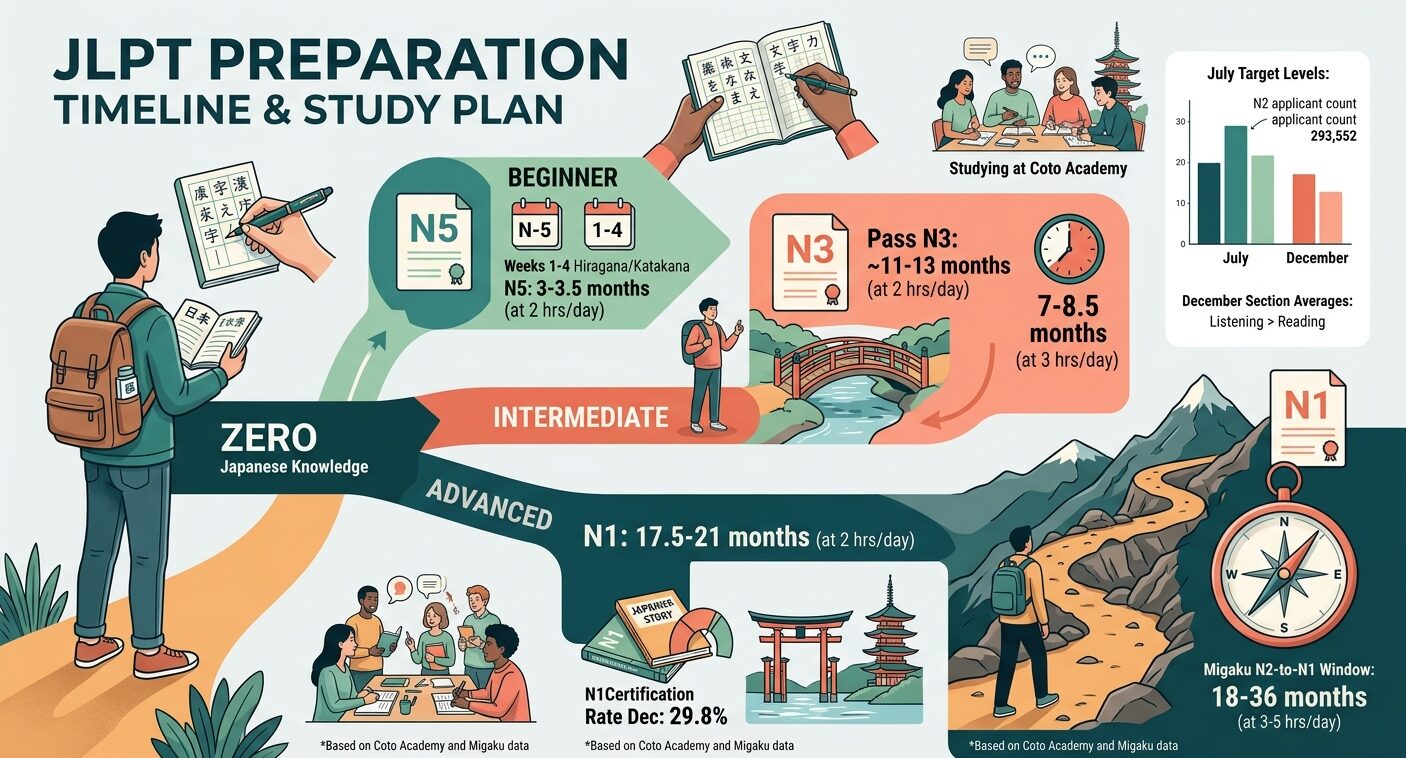
Coto Academy’s September 2026 update puts JLPT N3 at 660–770 cumulative study hours, about 11–13 months at 2 hours a day. Migaku’s March 2026 guide budgets 600–1,200 hours for the same level. This JLPT preparation timeline report turns both estimates into months and milestones by target level, then checks them against official December 2025 scores and preliminary July 2026 applicant counts.
JLPT Preparation Timeline and Study Plan by Target Level
Time to reach N3 from zero at 2 hours a day, per Coto Academy’s September 2026 update
Migaku’s N2-to-N1 window at 3–5 hours a day, March 2026 guide
N2 applicants for the July 2026 JLPT, the most of any level (preliminary, up 30.7%)
N5 average total vs pass mark in December 2025, the only level averaging above its pass mark
N1 certification rate in the December 2025 session, against 50.2% at N5
How Many Months Does Each JLPT Target Level Take at 1, 2 or 3 Hours a Day?
Coto Academy’s 2026 tables turn cumulative study hours into calendar time for every level of the JLPT from N5 to N1. The hours count from a learner’s first lesson, so N2’s 960–1,120 includes all N5–N3 study.
| Target level | Cumulative hours | 1 hour/day | 2 hours/day | 3 hours/day |
|---|---|---|---|---|
| N5 | 180–210 | ~6–7 months | ~3–3.5 months | ~2–2.5 months |
| N4 | 360–420 | ~12–14 months | ~6–7 months | ~4–4.5 months |
| N3 | 660–770 | ~22–26 months | ~11–13 months | ~7–8.5 months |
| N2 | 960–1,120 | ~32–37 months | ~16–19 months | ~11–12.5 months |
| N1 | 1,050–1,270 | ~35–42 months | ~17.5–21 months | ~12–14 months |
Source: Coto Academy, How Many Hours Does It Take to Pass JLPT? (2026 Update), September 2026
At 2 hours a day, Coto’s ranges run from about 3–3.5 months for N5 to 17.5–21 months for N1.
A learner who has already passed N3 needs about 300–350 more hours for N2, per Coto.
Coto ties the “N2 in two years” benchmark to full-time language-school students, who attend about 3 hours of class each weekday plus self-review.
Can You Pass N3 in One Year?
Yes, at 2–3 hours of daily study, per Coto. Its N3 row shows about 11–13 months at 2 hours and 7–8.5 months at 3 hours from a zero start.
Migaku’s Stage-by-Stage JLPT Study Plan by Target Level
| Target level | Hours from zero | Prep window | Daily hours | All level kanji by | Vocabulary target |
|---|---|---|---|---|---|
| N5 | 150–300 | 3 months | 2–3 | Weeks 9–12 (100) | 700–800 by weeks 9–12 |
| N4 | 300–600 | 4–6 months | 2–3 | Months 3–4 (300) | 1,500 by months 3–4 |
| N3 | 600–1,200 | 8–12 months | 2–4 | Months 4–6 (650) | 3,700 by months 7–9 |
| N2 | 1,200–2,400 | 12–18 months minimum | 3–4 | Months 5–8 (1,000) | 6,000 by months 9–12 |
| N1 | 2,400–4,800 | 18–36 months | 3–5 | Months 7–12 (2,000) | 10,000+ by months 13–24 |
Source: Migaku, JLPT Study Schedule guide, updated March 31, 2026
Each Migaku stage after N5 starts from the level below. N2 alone takes 12–18 months at minimum for a learner already at N3.
Kanji pace changes by stage: 3–4 new characters a day for N4, about 4 for N3, 3 for N2 and 5–6 for N1.
Weeks 1–4 of the N5 plan cover hiragana, katakana and the first 50 kanji, a stage where beginner Japanese worksheets add drills on greetings and numbers.
Listening takes a growing block of Migaku’s sample day: 30 minutes at N5, 60 at N3 and 120 at N1. Kanji study stays at 30 minutes in all three.
N1 Study-Hour Estimates Run From 1,050 to 4,800
N1 shows the widest spread in published hour estimates. Coto’s level table lists 1,050–1,270 cumulative hours, yet the same page gives two higher N1 figures tied to kanji background.
| N1 estimate on Coto Academy’s page | Study hours |
|---|---|
| Level table total (cumulative) | 1,050–1,270 |
| Learners who already know most kanji | ~2,150 |
| No prior kanji knowledge | 3,900–4,500 |
Source: Coto Academy, How Many Hours Does It Take to Pass JLPT? (2026 Update), September 2026
Migaku’s March 2026 guide sets N1 at 2,400–4,800 hours from zero and says few people pass without several years of serious study or immersion.
From month 7 of its N1 plan, Migaku makes immersion the main method, at 2–3 hours of native content a day; these at-home immersion activity ideas show ways to build that habit.
Coto reports that many learners spend one to three years on the N2-to-N1 step alone.
Where Do Candidates Fall Short? December 2025 Section Averages
N5 was the only level whose December 2025 average total, 83.3, sat above its overall pass mark of 80. N4 averaged 82.1 against 90, N3 87.7 against 95, N2 83.8 against 90 and N1 89.7 against 100.
| Level | Language knowledge | Reading | Listening | Average total |
|---|---|---|---|---|
| N1 | 28.2 / 60 | 28.0 / 60 | 33.5 / 60 | 89.7 |
| N2 | 24.3 / 60 | 24.7 / 60 | 34.8 / 60 | 83.8 |
| N3 | 27.9 / 60 | 26.5 / 60 | 33.4 / 60 | 87.7 |
| N4 | 52.6 / 120 (combined) | 29.5 / 60 | 82.1 | |
| N5 | 54.4 / 120 (combined) | 29.0 / 60 | 83.3 | |
Source: JLPT, Average Scores and Standard Deviations, December 2025 test (examinees who took all sections)
Listening posted the highest section average at N1, N2 and N3. Reading averaged 24.7 to 28.0 at those levels, and graded Japanese stories for learners offer extra reading practice outside test books.
Each scoring section also has a floor: 19 points per section at N1–N3, and 38 of 120 plus 19 of 60 at N4 and N5. One section below its floor means a fail, whatever the total.
Source: JLPT, Scoring Sections, Pass or Fail, Score Report (standards in force since 2010)
Certification rates in the same session were 29.8% at N1, 33.0% at N2, 31.2% at N3, 34.6% at N4 and 50.2% at N5. Earlier sessions appear in these JLPT pass rates by level and year.
Source: JLPT, Past Test Data, December 2025
Japan vs Overseas Score Gaps
| Level | Japan average total | Overseas average total |
|---|---|---|
| N1 | 86.1 | 92.4 |
| N2 | 78.9 | 88.8 |
| N3 | 85.0 | 91.2 |
| N4 | 81.6 | 82.5 |
| N5 | 84.9 | 83.2 |
Source: JLPT, Average Scores and Standard Deviations, December 2025 test
Overseas candidates averaged higher totals at N1–N4, while Japan-based candidates led at N5. The N2 gap was the widest, and N2 certification ran 25.4% in Japan against 40.9% overseas.
N2 Overtakes N3 as the Top Target Level in July 2026
Preliminary JLPT counts put July 2026 applicants at 943,671, up 4.3% on July 2025. The organizers say the overseas, Japan and combined totals were each the highest for a July session.
N2 drew 293,552 applicants, up 30.7%, ahead of N3 at 244,204. N3 had led the July 2025 session with 253,758.
N4 applications fell 17.5% to 171,470. N5 rose 14.1% to 92,360, and N1 rose 3.5% to 142,085.
Full-year 2025 applications reached 1,940,852 across 92 countries and areas, against 1,718,943 in 2024.
Source: JLPT, July 2026 Test Overview (preliminary, as of July 3, 2026); JLPT Past Test Data, 2024–2025
Japan vs Overseas Applicants by Level
| Level | Overseas applicants | Change vs July 2025 | Japan applicants | Change vs July 2025 |
|---|---|---|---|---|
| N1 | 78,032 | −8.1% | 64,053 | +22.4% |
| N2 | 134,870 | +5.3% | 158,682 | +64.3% |
| N3 | 138,942 | +4.2% | 105,262 | −12.6% |
| N4 | 130,389 | −0.1% | 41,081 | −46.9% |
| N5 | 85,410 | +12.5% | 6,950 | +39.7% |
| Total | 567,643 | +2.7% | 376,028 | +6.9% |
Source: JLPT, July 2026 Test Overview (preliminary, as of July 3, 2026)
N2 made up 42% of Japan applicants in July 2026, against 24% overseas, per JLPT’s published shares.
The Japan-side shift coincided with a 2026 JEES eligibility rule. For 2026, tests in Japan are, in principle, for non-native speakers who are mid-to-long-term or special permanent residents. JEES also cites a sharp rise in applicants that has made test sites hard to secure.
Overseas, China (including Hong Kong and Macau) led with 171,231 applicants, down 6.1%, ahead of South Korea at 90,846 (+11.5%) and Myanmar at 88,995 (−4.6%).
Source: JLPT, July 2026 Test Overview (preliminary); JEES, application notice, August 24, 2026
Planning a JLPT Preparation Timeline Around the 2026 Test Dates
The 2026 JLPT sessions fall on July 5 and December 6, and some cities outside Japan hold only one. Fees also differ by host country, as this JLPT fee comparison across countries shows.
JEES posted on September 3, 2026 that December applications in Japan had closed, ahead of its announced September 7 deadline. Candidates in Japan can apply for one level per session.
For the July 2026 test in Japan, JEES scheduled online results on MyJLPT for late August and mailed result notices on September 25. Overseas, the JLPT FAQ schedules score reports for early October after July and early March after December.
Source: JLPT, FAQ, 2026; JEES, JLPT notices, August–September 2026
Which JLPT Level Matches CEFR B1, B2 or C1?
Since the December 2025 test, passing score reports show a CEFR reference level based on total score. A pass at N2 maps to B2 only at 112 points or more.
| Level | Overall pass mark | CEFR reference by total score |
|---|---|---|
| N5 | 80 | A1 (80+) |
| N4 | 90 | A2 (90+) |
| N3 | 95 | A2 (95–103), B1 (104+) |
| N2 | 90 | B1 (90–111), B2 (112+) |
| N1 | 100 | B2 (100–141), C1 (142+) |
Source: JLPT, Indication of the CEFR Level for Reference (from the December 2025 test); JLPT pass marks
Candidates who fail get no CEFR level, including those who clear the total but miss a sectional floor.
FAQs
How long does it take to prepare for JLPT N3?
About 11–13 months from zero at 2 hours a day, or 7–8.5 months at 3 hours, per Coto Academy’s September 2026 estimate of 660–770 cumulative hours. Migaku’s plan allows 8–12 months starting from N4.
How many hours a day should I study for the JLPT?
Migaku’s 2026 plans use 2–3 hours a day for N5 and N4, 2–4 for N3, 3–4 for N2 and 3–5 for N1. At 1 hour a day, Coto’s tables stretch N2 to about 32–37 months.
Is the “N2 in two years” benchmark discussed on Reddit realistic?
Yes for intensive learners. Coto Academy links it to full-time language-school students with about 3 hours of class a day. Its tables put N2 at about 16–19 months at 2 hours a day, but 32–37 months at 1 hour.
Which JLPT level has the lowest pass rate?
N1, at 29.8% certified worldwide in the December 2025 session. N3 followed at 31.2%, then N2 at 33.0%, N4 at 34.6% and N5 at 50.2%, according to JLPT data.
How long does it take to go from N2 to N1?
Between 18 and 36 months at 3–5 hours a day, in Migaku’s 2026 plan. Coto Academy says many learners spend one to three years on that step, even after years of study to reach N2.
