

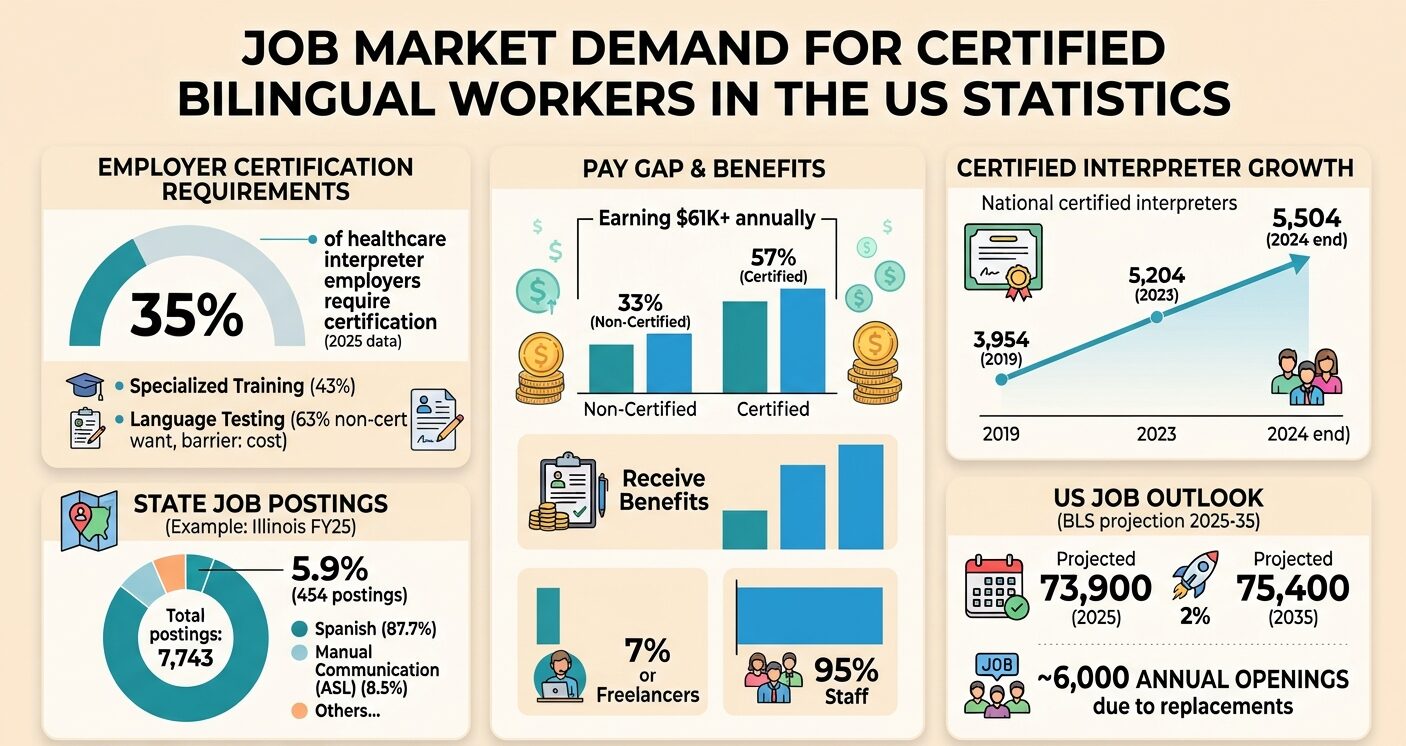
Just 35% of employers require certification, based on interpreters surveyed by the Certification Commission for Healthcare Interpreters (CCHI) in early 2025. Yet 57% of certified respondents earned $61,000 or more, against 33% of non-certified ones.
This guide to job market demand for certified bilingual workers in the US covers credential rules, certified headcounts, pay gaps, court and state hiring data, and the BLS outlook to 2035.
Job Market Demand For Certified Bilingual Workers In The US Statistics 2026
How Many Employers Require Certified Bilingual Workers?
Certification is the exception in healthcare interpreting. CCHI’s Global Workforce Survey, fielded January to March 2025 with 1,444 valid responses, found 35% of employers require it.
Language testing is also uneven. Over a quarter of organizations skip proficiency testing entirely.
| Employer requirement | Share of respondents |
|---|---|
| Require specialized healthcare interpreter training | 43% |
| Require certification | 35% |
| Require proficiency testing in both working languages | 34% |
| Do not require language proficiency testing | 26% |
Source: CCHI, Global Workforce Survey of Healthcare Interpreters, January–March 2025
Demand for the credential runs ahead of employer rules. Of non-certified respondents, 77% want certification, and 63% name cost as the main barrier, a pattern that mirrors what language courses cost in major US cities.
Staff interpreters held certification at a higher rate (76%) than freelancers (59%).
Courts Set a Firmer Bar
Court work is different. BLS notes that most states require certification for court interpreters.
Federal courts have certified interpreters in Spanish, Navajo, and Haitian Creole. The Federal Court Interpreter Certification Examination is currently offered for Spanish/English only.
Source: U.S. Bureau of Labor Statistics, Occupational Outlook Handbook, updated August 27, 2026; Administrative Office of the U.S. Courts, FCICE program
The school pipeline is national. A March 2024 U.S. Department of Education NCELA brief reports the Seal of Biliteracy has spread to all 50 states and DC.
Adults outside school can test through standalone Spanish exams, covered in this DELE vs SIELE candidate and pricing breakdown.
Source: U.S. Department of Education, NCELA State Seal of Biliteracy infographic, March 2024
57% vs 33%: The Pay Gap for Certified Bilingual Interpreters
The chart shows the share of certified and non-certified respondents in three pay brackets, from CCHI’s 2025 survey of interpreters serving U.S. healthcare.
Non-certified interpreters sit at the bottom more often: 37% reported $20 or less per hour.
Employment type shapes pay too. Staff interpreters (62%) were more likely than freelancers (26%) to earn 21–30 per hour.
Benefits split wider still: 95% of staff interpreters receive them, compared with 7% of freelancers.
The survey covers healthcare interpreting only, so it does not measure salary premiums for bilingual employees in other US industries.
Source: CCHI, Executive Summary of the Global Workforce Survey of Healthcare Interpreters, fielded January–March 2025
Certified Healthcare Interpreter Count, 2019–2024
CCHI counted 5,504 nationally certified healthcare interpreters at the end of 2024, up from 5,204 a year earlier and 3,954 at the end of 2019.
Source: CCHI Annual Reports, 2019–2024, year-end counts
Spanish leads the credential mix, with 3,877 CHI-Spanish holders among active certificants.
| CCHI credential | Active certificants |
|---|---|
| CHI-Spanish | 3,877 |
| CoreCHI | 970 |
| CHI-Mandarin | 233 |
| CHI-Arabic | 222 |
| CoreCHI-Performance | 202 |
Source: CCHI 2024 Annual Report, as of December 31, 2024
Bilingual exam pass rates in 2024 ranged from 72.1% for CHI-Arabic to 83.3% for CHI-Mandarin. CHI-Spanish candidates passed at 81%.
CCHI began sunsetting CoreCHI on January 1, 2025. Holders must pass the ETOE performance exam and earn CoreCHI-P to stay certified.
Source: CCHI 2024 Annual Report; CCHI certifications page, accessed 2026
Why Is Court Interpreter Certification So Hard to Pass?
California’s Bilingual Interpreting Examination had an 8% overall pass rate in 2024. Candidates in the state’s free near-passer training passed at 23%.
As of March 2025, California’s Master List held 1,856 court interpreters: 1,702 certified and 154 registered, across 114 spoken languages plus ASL.
Age adds pressure, with 32% of listed interpreters over 65.
Spanish accounted for 88.0% of interpretations in California superior courts from FY 2020–21 through FY 2023–24.
Contractor interpreter spending rose 42% in FY 2023–24 over the prior year. The state’s interpreter appropriation reached $134.8 million in FY 2024–25.
A workforce pilot that reimburses training and exam costs drew over 1,000 applications for its first cohort. Nineteen courts selected 140 participants.
Source: Judicial Council of California, 2025 Language Need and Interpreter Use Study, June 2025
Bilingual Job Postings in Illinois State Government, FY25
Illinois agencies posted 7,743 jobs in FY25 (July 2024 to June 2025). Of those, 454, or 5.9%, were bilingual positions.
Hires into those roles earn bilingual pay of $100 per month or 5% of base salary, whichever is higher.
| Language required | Bilingual postings | Share of bilingual postings |
|---|---|---|
| Spanish | 398 | 87.7% |
| Manual Communication | 39 | 8.5% |
| Polish | 6 | 1.3% |
| Arabic | 4 | 0.9% |
Source: Illinois Department of Central Management Services, FY25 Bilingual Needs and Bilingual Pay Report, July 1, 2024–June 30, 2025
Bilingual headcount grew faster than the wider workforce. Employees in bilingual positions rose 14.6% in FY25, against 3.9% for the overall state workforce.
Agencies added bilingual designations to 43 position descriptions and removed them from 6.
As of September 8, 2025, 2,325 state employees received bilingual pay, and 1,868 of them held Spanish-language positions.
FY25 also brought a standardized Spanish assessment for interviews in bilingual-coded positions.
Recognized skills trail self-reported ones. In a voluntary survey of 10,596 employees, 18.4% reported proficiency in another language, while 4.2% of the 56,000-person workforce held bilingual positions.
The report cites 2024 ACS data showing 24.5% of Illinois residents speak a language other than English at home, a figure that can be set against other bilingualism rates by US state.
Source: Illinois CMS, FY25 Bilingual Needs and Bilingual Pay Report; pay counts as of September 8, 2025
What Is the US Job Outlook for Bilingual Interpreters Through 2035?
BLS counted 73,900 interpreter and translator jobs in 2025 and projects 75,400 by 2035, a 2% rise. The average for all occupations is 3%.
Openings still run about 6,000 a year, mostly to replace workers who retire or change occupations.
The median annual wage was $60,170 in May 2025. The prior edition reported $59,440 for May 2024.
Source: U.S. Bureau of Labor Statistics, Occupational Outlook Handbook, 2025–35 projections and May 2025 OEWS wages
Where Interpreter and Translator Jobs Sit
Professional, scientific, and technical services held 30% of jobs in 2025, followed by self-employed workers at 28%.
Educational services employed 15%. Language teachers are a separate BLS occupation, tracked in this language teacher salary breakdown by state.
Source: BLS, Occupational Outlook Handbook, share of interpreter and translator jobs, 2025
Interpreter Pay by Industry, May 2025
| Industry | Median annual wage |
|---|---|
| Government, excluding state and local education and hospitals | $74,320 |
| Hospitals; state, local, and private | $63,000 |
| Educational services; state, local, and private | $61,230 |
| Professional, scientific, and technical services | $60,850 |
Source: BLS, OEWS via Occupational Outlook Handbook, May 2025 (excludes self-employed workers)
Pay spreads wide. The lowest 10% earned under $37,070, and the top 10% earned over $103,660.
BLS says AI tools make translation work more efficient, but most of these jobs cannot yet be fully automated.
In CCHI’s 2025 survey, 18% of healthcare interpreters reported using AI tools. Vendor revenue trends sit in a different dataset, covered in this AI translation market forecast.
Source: BLS Occupational Outlook Handbook, May 2025; CCHI Global Workforce Survey, January–March 2025
Earlier Bilingual Job Market Demand Data (2015–2019)
New American Economy’s 2017 report, built on Burning Glass posting data, counted roughly 240,000 job postings aimed at bilingual workers in 2010. By 2015, the count was about 630,000.
In 2015, 60% of the jobs with the highest bilingual demand were open to candidates without a bachelor’s degree.
California held 19.4% of bilingual job ads that year, while home to 12.4% of the U.S. working-age population.
Source: New American Economy (now American Immigration Council), Not Lost in Translation, March 2017, covering 2010–2015
ACTFL’s 2019 survey of 1,200 U.S. employers found 9 in 10 rely on employees with language skills other than English. Of those surveyed, 56% expected their language demand to rise within five years.
One in three language-dependent employers reported a skills gap. One in four said they lost business due to a lack of language skills.
Source: ACTFL, Making Languages Our Business, 2019
FAQs
Is there demand for bilingual workers in the US?
Yes. BLS projects about 6,000 interpreter and translator openings a year from 2025 to 2035. Illinois state agencies posted 454 bilingual positions in FY25, or 5.9% of all state job postings.
Do certified bilingual employees get paid more?
Often, yes. In CCHI’s 2025 survey, 57% of certified healthcare interpreters earned $61,000 or more, versus 33% of non-certified ones. Illinois adds $100 a month or 5% of base pay for state bilingual positions.
How many certified medical interpreters are there in the US?
CCHI counted 5,504 nationally certified healthcare interpreters at the end of 2024, including 3,877 CHI-Spanish holders. That total covers CCHI credentials, not other certifying bodies.
How much do interpreters and translators make?
BLS reports a median of $60,170 a year, or $28.93 an hour, in May 2025. The lowest 10% earned under $37,070, and the top 10% earned over $103,660.
Reddit users ask if interpreter certification is worth it. What does the data say?
On pay, the 2025 CCHI survey favors certification: 57% of certified interpreters earned $61,000 or more, against 33% of non-certified. Cost is the main hurdle, cited by 63% of non-certified respondents.
Sources
https://www.bls.gov/ooh/media-and-communication/interpreters-and-translators.htm
https://cchicertification.org/uploads/CCHI_ExecutiveSummary_GlobalWorkforceSurveyHCI_Report-2025.pdf
https://cms.illinois.gov/content/dam/soi/en/web/cms/documents/CMS_FY25%20BNBP.pdf
