

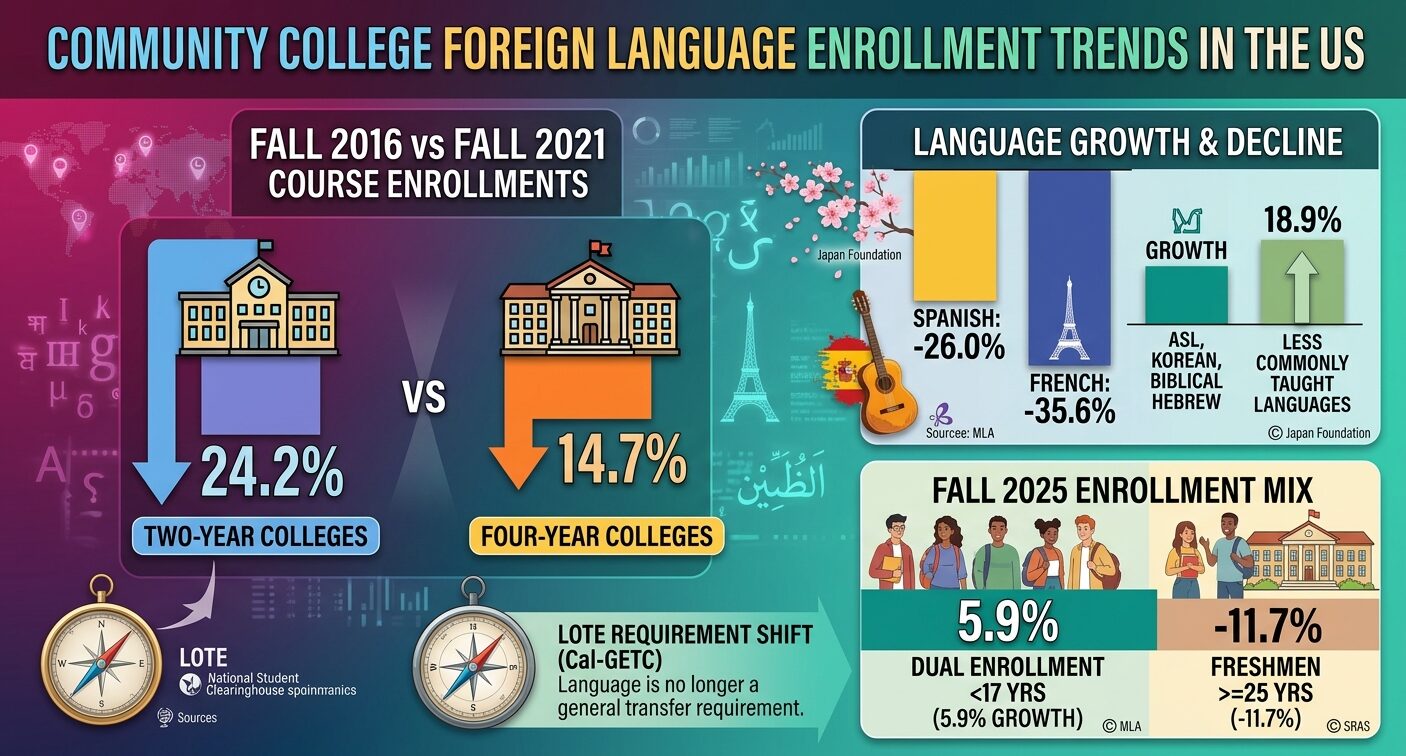
Community colleges added 173,000 students in fall 2025, a 3.0% rise. The newest national count of their language classes is four years older. The Modern Language Association’s fall 2021 census put two-year college language course enrollments 24.2% below fall 2016.
This page tracks community college foreign language enrollment trends from that census through 2023-24 campus reviews, the Japan Foundation’s 2024 survey, SRAS’s fall 2025 Russian count and California’s Cal-GETC change.
Community College Foreign Language Enrollment Trends
How Far Have Community College Foreign Language Enrollments Fallen?
Two-year colleges lost language course enrollments faster than four-year schools in both of the MLA’s last two census intervals.
Between fall 2016 and fall 2021, two-year enrollments fell 24.2% and four-year enrollments fell 14.7%. The earlier interval, fall 2013 to fall 2016, showed drops of 15.9% and 7.3%.
The MLA counts course enrollments, not students, so one student in two language courses counts twice. Its fall 2021 census covered 2,455 colleges, a 92.2% response rate, with about one-third of responses from two-year institutions.
Source: Modern Language Association, Enrollments in Languages Other Than English, fall 2016 and fall 2021 reports
Spanish and French fell harder at two-year colleges than across all institutions. Less commonly taught languages moved the other way, adding 837 enrollments at two-year schools.
| Language group | Change in two-year college course enrollments, fall 2016 to fall 2021 |
|---|---|
| All languages | -24.2% |
| Spanish | -26.0% |
| French | -35.6% |
| Less commonly taught languages | +18.9% |
Source: Modern Language Association, Enrollments in Languages Other Than English in US Institutions of Higher Education, fall 2021
Across all institutions, three of the 15 most-taught languages grew from 2016 to 2021: Korean (+38.3%), Biblical Hebrew (+9.1%) and American Sign Language (+0.8%). ASL’s wider user base is tracked in these ASL user statistics.
The MLA’s enrollment page still lists the fall 2021 report as current. It says data gathering for the next report was scheduled to begin in fall 2024.
Source: Modern Language Association enrollment reports page, checked October 2026
Foothill College Spanish Headcount Fell From 716 to 604
Campus program reviews carry the trend past 2021. Foothill College’s 2024-25 Spanish review shows unduplicated headcount down 15.6% between 2019-20 and 2023-24.
Course enrollments fell 16.6% to 741 over the same five years. Full-time equivalent students (FTES) fell 22.7% to 75.
The department places its largest losses in face-to-face Spanish 1 and Spanish 2, and in students moving from Spanish 1 to Spanish 2. Online Spanish 1 doubled in size, and Spanish 3 grew.
Course success stood at 75% in 2023-24, against 79% in 2019-20. Sections offered dropped from 37 to 35.
Source: Foothill College, Spanish Comprehensive Program Review 2024-25, 2019-20 to 2023-24 data
The program’s makeup shifted too. Latinx students rose from 25% to 35% of Spanish enrollments over the five years.
| Race/ethnicity | 2019-20 (888 enrollments) | 2023-24 (741 enrollments) |
|---|---|---|
| Asian | 21% | 19% |
| Black | 5% | 4% |
| Filipinx | 4% | 3% |
| Latinx | 25% | 35% |
| Native American | 1% | 1% |
| Pacific Islander | 1% | 1% |
| Unknown ethnicity | 6% | 2% |
| White | 37% | 35% |
Source: Foothill College, Spanish Comprehensive Program Review 2024-25, 2019-20 and 2023-24
The department plans to grow its Spanish for Healthcare Workers sequence, adding Spanish 51C in 2025-26 with a certificate in development. Employer demand for that skill set shows up in bilingual salary premium data.
Community College Foreign Language Enrollment Trends by Student Type
Community college enrollment rose 3.0% in fall 2025 and 3.1% in spring 2026, based on National Student Clearinghouse data. The fall growth leaned on high school students.
Dual enrollment, covering students aged 17 and under, rose 5.9% to 1.19 million in fall 2025. That is nearly 20% of community college students.
Community college freshmen aged 25 or older fell 11.7%. Certificate programs at community colleges enrolled 752,000 students, up 28.3% from fall 2021.
Source: National Student Clearinghouse Research Center, Final Fall Enrollment Trends (fall 2025) and Final Spring Enrollment Trends (spring 2026)
De Anza College shows that mix inside a language department. Its World Languages program, which excludes Spanish, recorded 1,317 unduplicated students in 2023-24, against 1,344 in 2022-23.
The department’s updated mission names dual enrollment students first, ahead of transfer students and lifelong learners. De Anza lets California high school students in grades 9 to 12 take classes free; adults outside that route can compare language course costs across major US cities.
Certificate awards rose from 11 to 13 in the first two years De Anza offered them. New certificates in Hindi, Japanese and Vietnamese have since been created.
| Language | Certificates, 2022-23 | Certificates, 2023-24 |
|---|---|---|
| French | 3 | 3 |
| German | 0 | 4 |
| Italian | 3 | 1 |
| Korean | 3 | 1 |
| Russian | 2 | 4 |
| Total | 11 | 13 |
Source: De Anza College, World Languages Program Review Annual Update, 2022-23 and 2023-24
The department reports more demand for online courses and no new full-time hire since its last comprehensive review. It planned to offer Sign 3 in spring 2025 as Sign 2 enrollments rose.
Did Cal-GETC Change Community College Foreign Language Enrollment?
Cal-GETC became California’s transfer general education pattern in fall 2025. Language Other Than English (LOTE) is no longer a required area.
LOTE still counts after transfer. A UC memo dated September 15, 2025 says LOTE remains a graduation requirement for many UC colleges and adds an optional LOTE certification to the Cal-GETC form. UC Santa Cruz has no LOTE graduation requirement.
Source: University of California Admissions, Cal-GETC LOTE memo, September 15, 2025
De Anza’s World Languages review flagged the shift before it took effect. The department wrote that it was unsure how the new transfer rules would affect its language enrollment.
ACTA links requirement levels to enrollment. Its 2026 report found language course enrollments equal to 22% of the undergraduate body at schools requiring intermediate study, 12% with an elementary requirement and 9% with none.
Only 11% of the four-year liberal arts institutions ACTA rates required intermediate-level language study as of 2025, down from 13% in 2013. Among the 50 state flagships, 15 (30%) required it.
The report names community colleges and non-flagship public institutions among schools that have cut language programs. It describes language departments as usually the first to take cuts when a college faces financial strain.
Source: American Council of Trustees and Alumni, Ivory Tower of Babel, 2026 (requirement data as of 2025; enrollment ratios drawn from MLA fall 2021 data)
Japanese, Russian and Native Language Programs: 2024 to 2026 Data
Japanese: 54,701 Learners in US Higher Education, 2024
The Japan Foundation’s 2024 survey counted 134,096 Japanese learners in the US, against 161,402 in its 2021 survey. Higher education held 54,701 of them, just above secondary schools at 54,383.
Institutions teaching Japanese fell from 1,241 to 1,155. Teachers fell from 4,109 to 3,780.
The foundation reports a smaller decline in higher education than in K-12. It links the college drop to schools removing language graduation requirements and to fewer undergraduate students from East Asia, a group tracked in international student enrollment figures.
Interest in anime, manga, J-POP and fashion was cited by 92.2% of North American institutions in 2024. Learners who go on to certify can check JLPT pass rates by level and year.
Source: Japan Foundation, Survey on Japanese-Language Education Abroad 2024 (fieldwork September to December 2024)
Russian: 12 Program Closures in SRAS’s Fall 2025 Survey
| SRAS college Russian survey, fall 2025 | Programs |
|---|---|
| Contacted | 307 |
| Valid responses | 226 |
| Active fall 2025 enrollment | 202 |
| Reported permanent closure | 12 |
| Suspended | 8 |
| Summer-only | 3 |
Source: SRAS, Survey of Enrollments in Russian Language Classes, fall 2025
Average enrollment held at 34.4 per program, against 34.5 in 2024. SRAS says closures propped up that average, since 8% to 9% of reporting programs were cancelled or suspended and nearly all sat below it.
Unmet enrollment minimums were among the reasons given for suspension. Eight more programs expect to close within three years.
SRAS’s cumulative list of confirmed closures since the survey began includes three community colleges: Everett Community College, Grossmont College and Riverside Community College.
Native Languages at Central Oregon Community College
Central Oregon Community College’s June 10, 2026 program review response says Native languages are effectively no longer offered. The total number of languages offered has decreased.
World Languages enrollment stabilized after a post-pandemic drop but remains below pre-pandemic levels. Reviewers discussed Spanish for Specific Purposes courses, possibly focused on healthcare, to raise enrollment.
Source: Central Oregon Community College, World Languages Department and Program Review response, June 2026
After Transfer: Humanities Majors Down 28% Since Fall 2015
Students working toward a humanities bachelor’s degree as a first major fell from 556,369 in fall 2015 to 398,589 in fall 2025. The American Academy of Arts & Sciences analyzed the Clearinghouse data.
Humanities majors made up 4.8% of bachelor’s degree seekers in fall 2025, down from 6.6% in 2015. Bachelor’s degrees in languages and literatures other than English fell 50.8% between 2012 and 2025.
Source: American Academy of Arts & Sciences, Humanities Indicators, September 2026 (enrollment fall 2015 to fall 2025; degrees 2012 to 2025)
FAQs
Are foreign language enrollments declining at community colleges?
Yes, on the latest national count. The MLA’s fall 2021 census found two-year college language course enrollments down 24.2% from fall 2016, after a 15.9% drop between fall 2013 and fall 2016.
Why are colleges cutting language programs?
Sources cite different factors. The Japan Foundation points to dropped graduation requirements and fewer East Asian students. SRAS lists unmet enrollment minimums among suspension reasons. ACTA’s 2026 report cites budget strain.
Which languages are gaining college enrollments?
Korean led the MLA’s fall 2021 census at +38.3% since 2016, followed by Biblical Hebrew (+9.1%) and American Sign Language (+0.8%). At two-year colleges, less commonly taught languages rose 18.9%.
I saw on Reddit that California transfer students no longer need a language. Is that true?
Partly. Cal-GETC, effective fall 2025, dropped Language Other Than English as a required transfer area. Many UC colleges still require it to graduate, and students can add an optional LOTE certification.
When will new national college language enrollment data come out?
The MLA has not posted a release date. Its enrollment page still lists fall 2021 as the current report and says data gathering for the next one was scheduled to begin in fall 2024.
