

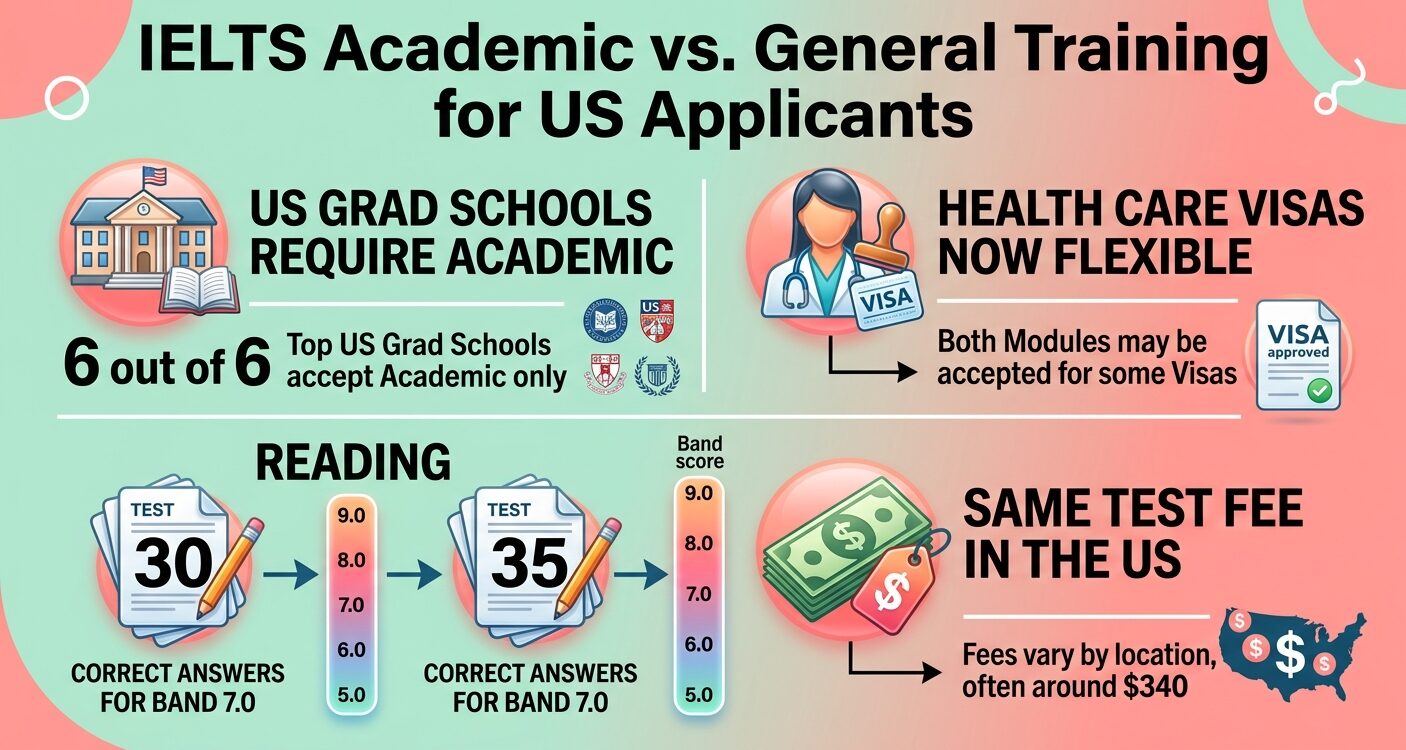
Thirty correct Reading answers earn band 7.0 on IELTS Academic, while General Training needs 35 for the same band, based on IELTS’s published averages. For US applicants, that gap is half of the IELTS Academic vs General Training decision, and acceptance rules are the other half.
This post covers section differences, 2024-25 score data, six US graduate school policies checked in October 2026, the May 2026 health care visa list, fees and enrollment data.
IELTS Academic vs General Training
Reading Splits IELTS Academic vs General Training: 30 vs 35 Answers for Band 7
Listening and Speaking are identical in both modules. Reading and Writing are the two sections that differ, according to IELTS.
IELTS points General Training candidates toward migration to English-speaking countries such as Australia, Canada, New Zealand and the UK, or toward training below degree level. The United States is not on that list.
Both Reading tests are marked out of 40 and reported on the same nine-band scale. The raw-to-band conversion differs at every published point.
| Correct answers (out of 40) | IELTS Academic Reading band | IELTS General Training Reading band |
|---|---|---|
| 15 | 5 | 4 |
| 23 | 6 | 5 |
| 30 | 7 | 6 |
| 35 | 8 | 7 |
Source: IELTS, IELTS scoring in detail, average marks per band, page checked October 2026
Band 7.0 takes 30 correct answers on Academic and 35 on General Training. At band 6.0 the gap is seven answers, 23 against 30.
IELTS says Academic texts may use harder vocabulary or a more complex style, and that exact marks vary slightly between test versions.
Is IELTS General Training Easier Than Academic?
Not on Reading scoring. General Training needs more correct answers per band, and its 2024-25 Reading mean was lower.
| Test section (2024-25) | Mean band | Standard deviation | Standard error of measurement |
|---|---|---|---|
| Listening (both modules) | 6.45 | 1.36 | 0.43 |
| Academic Reading | 6.32 | 1.26 | 0.36 |
| General Training Reading | 6.05 | 1.56 | 0.47 |
Source: IELTS test statistics, Listening and Reading sections used in 2024-25
General Training Reading posted a 6.05 mean against 6.32 for Academic Reading. Its standard deviation of 1.56 was the widest of the three sections.
Composite reliability was 0.97 for both modules in the same release. The composite standard error of measurement was 0.17 for Academic and 0.19 for General Training.
Nationality and gender breakdowns from the IELTS partnership’s data files are compiled in IELTS test taker volumes and band data.
Which IELTS Module Do US Graduate Schools Accept?
| Graduate school | Module named | Overall IELTS score | Section floor | One Skill Retake | Online or home test |
|---|---|---|---|---|---|
| UC Berkeley Graduate Division | Academic Modules | 7 | 6.5 Speaking and Writing (tests from 21 Jan 2026) | Not accepted | IELTS Online accepted |
| Harvard Griffin GSAS | IELTS Academic | 7 | 6.5 Speaking | Not stated | Accepted |
| University of Washington Graduate School | Academic IELTS | 6.5 minimum; 7.0 recommended | None stated | Not admissible | Test center or home |
| Illinois Graduate College | IELTS Academic | 6.5 limited status; 7.5 full status | None stated | Not accepted | In person and online |
| Cornell Graduate School | IELTS Academic | 7.0 (summer and fall 2026 admission) | None stated for admission | Not stated | Only if no safe in-person option |
| MIT GradAdmissions | IELTS Academic | 7 (recommended minimum) | None stated | Not accepted | Not stated |
Source: Graduate admissions pages of UC Berkeley, Harvard Griffin GSAS, University of Washington, University of Illinois Urbana-Champaign, Cornell and MIT, checked October 2026
All six name the Academic module, and none lists General Training. The University of Washington adds that other tests or versions do not qualify.
Four of the six refuse IELTS One Skill Retake results: Berkeley, Washington, Illinois and MIT.
Berkeley is the one school of the six with Speaking and Writing floors, 6.5 each, for tests taken on or after 21 January 2026. It will not accept tests taken before 1 June 2025 for Fall 2027 entry.
Harvard accepts fall 2027 scores from tests taken no earlier than 5 January 2025. Cornell says its minimums are expected to rise for summer and fall 2027 admission.
Washington’s 6.5 does not satisfy its requirement without conditions. Admitted students below 7.0 must complete Academic English Program courses.
The British Council says IELTS is accepted by over 3,400 US institutions and programmes. Program-level thresholds beyond these six are compared in IELTS band requirements at top US universities.
Source: British Council, IELTS in the United States, page checked October 2026
US Health Care Visas: IELTS Academic vs General Training After 12 May 2026
HRSA’s previous list limited General Training to health care workers below B.S. level. The list in force from 12 May 2026 sets IELTS scores without naming a module.
| HRSA occupation group | IELTS score, 24 May 2022 to 12 May 2026 | IELTS score from 12 May 2026 |
|---|---|---|
| Occupational Therapists/Physical Therapists | Not applicable | 6.5 Overall, 7 Speaking |
| Registered Nurses and other B.S. level Health Care Workers | 6.5 academic, minimum of 7 on Speaking | 6.5 Overall, 7 Speaking |
| <B.S. level Health Care Workers | 6 academic or general, minimum of 7 on Speaking | 6 Overall, 7 Speaking |
Source: HRSA, Updated list of Tests and Scores for Foreign Health Care Workers, as of 12 May 2026, and the list in force from 24 May 2022 to 12 May 2026
The old list marked IELTS as not applicable for occupational and physical therapists. The new list sets 6.5 overall with 7 in Speaking for them, matching registered nurses.
Does VisaScreen Accept General Training?
TruMerit, formerly CGFNS International, issues VisaScreen certificates and names Academic IELTS on its approved exam list. It does not accept at-home versions of any English exam.
Exams taken before 12 May 2026 are assessed under the previous HRSA table, per TruMerit.
Source: TruMerit, VisaScreen English requirement, page checked October 2026
The regulation text at 8 CFR 212.15 still says the 6.0 IELTS score allows either the Academic or the General module.
Source: eCFR, 8 CFR 212.15, current text checked October 2026
How Did US International Enrollment Shift Before Fall 2026?
Open Doors 2024/25
Total international enrollment rose 4.5% to 1,177,766 in 2024/25. New enrollment fell 7.2% to 277,118, and graduate enrollment fell 2.7%.
India sent 363,019 students and China 265,919. National English levels for both are tracked in English proficiency rankings by country.
| Group (2024/25) | International students | Change vs 2023/24 |
|---|---|---|
| All international students | 1,177,766 | +4.5% |
| Undergraduate | 357,231 | +4.2% |
| Graduate | 488,481 | −2.7% |
| New international enrollment | 277,118 | −7.2% |
Source: IIE, Open Doors 2025 Fast Facts, academic year 2024/25
IIE Snapshots and IDP Volumes, Fall 2025 to June 2026
IIE’s Fall 2025 Snapshot, drawn from 828 responding institutions, put new international enrollment down 17% and total enrollment down 1%. Graduate enrollment fell 12%.
Source: IIE, Fall 2025 Snapshot on International Student Enrollment, November 2025
In IIE’s Spring 2026 Snapshot, 59% of 585 responding institutions reported fewer international applications for 2026/27, and 63% expected international enrollment to decline.
Source: IIE, Spring 2026 Snapshot on International Educational Exchange, 585 institutions surveyed May to June 2026
IDP Education, an IELTS co-owner, logged 1,195.4 thousand English Language Testing volumes in the 12 months to 30 June 2026, down 8% from 1,293.8 thousand. IDP counts tests across all test types, not IELTS alone.
India IELTS volumes fell 22%, and IELTS volumes outside India fell 3%. IDP’s student placements to the US fell 67%.
None of these figures splits Academic from General Training.
Source: IDP Education, FY26 Financial Results presentation, 20 August 2026, 12 months to 30 June 2026
IELTS Academic vs General Training Cost the Same: $340 at ELS From October 2026
ELS says all its listed US IELTS centers offer both modules. From 1 October 2026 the fee is $325 plus a $15 non-refundable admin fee, $340 in total.
Cleveland and Nashville charge $365 plus the $15 fee, or $380.
Source: ELS IELTS Test Centers, fees effective 1 October 2026
The British Council lists US IELTS fees of $280 to $340 depending on location, with Academic and General Training available at the same price.
Source: British Council, IELTS in the United States, page checked October 2026
Preparation costs sit outside the test fee, whether through classes or language learning apps.
FAQs
Does the US accept IELTS General Training?
For graduate admission, not at the six schools checked: Berkeley, Harvard, Washington, Illinois, Cornell and MIT name IELTS Academic. HRSA’s health care list from 12 May 2026 names no module, but TruMerit’s VisaScreen list specifies Academic IELTS.
Is IELTS General Training easier than Academic?
Not on Reading scoring. IELTS lists 35 correct answers for band 7.0 on General Training against 30 on Academic. The 2024-25 General Training Reading mean was 6.05, below Academic’s 6.32.
Which IELTS do US universities require?
IELTS Academic. The six graduate schools checked in October 2026 publish overall thresholds from 6.5 to 7.5, and Berkeley adds 6.5 floors in Speaking and Writing for tests from 21 January 2026.
Do IELTS Academic and General Training cost the same?
Yes. ELS centers in the US charge one fee for either module: $325 plus a $15 admin fee, $340 total, from 1 October 2026. Cleveland and Nashville charge $380.
Is the Reddit claim that General Training is easier accurate?
The claim rests on Reading texts. IELTS says Academic texts may carry harder vocabulary, but General Training needs more correct answers per band: 30 correct earns 7.0 on Academic and 6.0 on General Training.
Sources
