

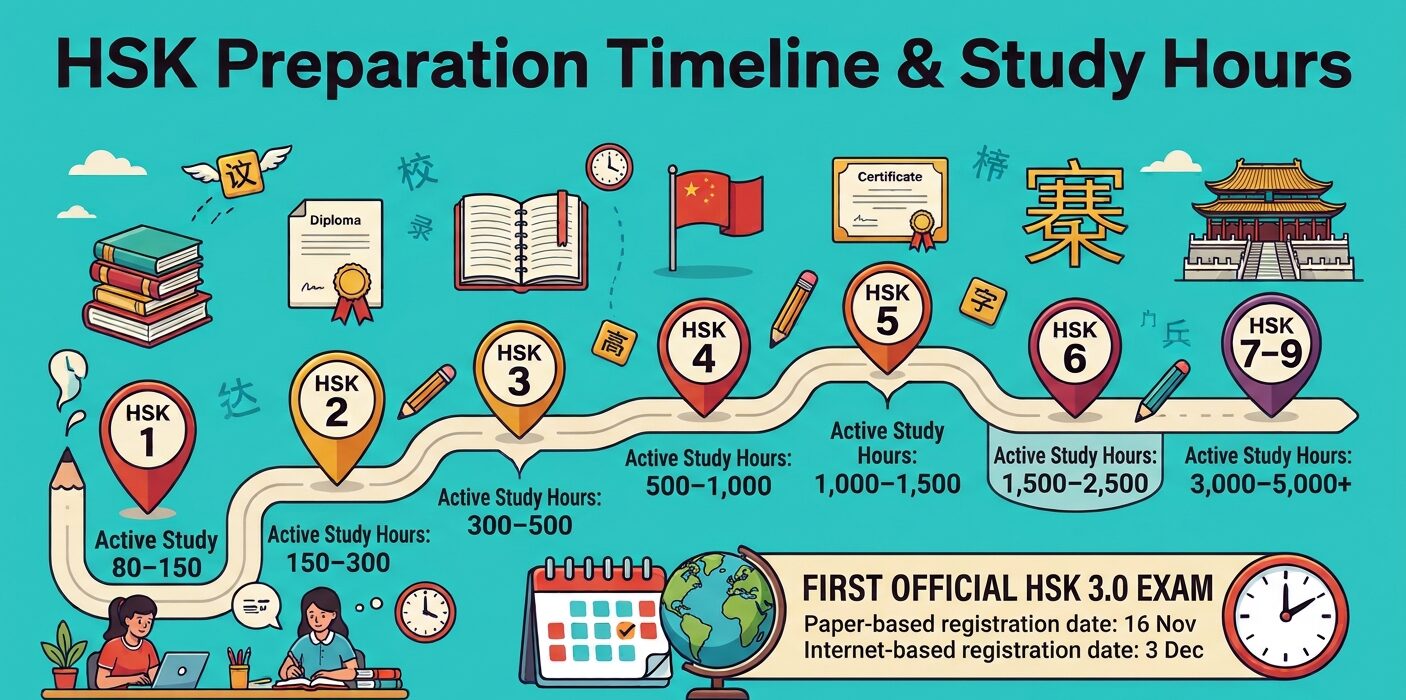
HSKStory’s October 2026 planning bands put HSK 1 at 80–150 hours of active study and the shared HSK 7–9 band at 3,000–5,000+ hours. The first official HSK 3.0 exam follows on 13 December 2026.
This guide sets out the HSK preparation timeline for each level in hours and calendar time, checks it against the 2025 syllabus and exam format, and shows where published estimates split.
HSK Preparation Timeline
How Long Does Each HSK Level Take From Zero?
HSKStory’s bands, updated 8 October 2026, climb from 80–150 cumulative active-study hours for HSK 1 to 3,000–5,000+ hours for HSK 7–9. At 10 active hours a week, that is 2–4 months at the bottom and 6–10+ years at the top.
The bands assume an adult beginner studying through English, with no prior literacy in a character-based language. Passive background listening does not count.
| HSK level | Cumulative active-study hours | At 10 active hours a week |
|---|---|---|
| HSK 1 | 80–150 | 2–4 months |
| HSK 2 | 150–300 | 4–7 months |
| HSK 3 | 300–500 | 7–12 months |
| HSK 4 | 500–1,000 | 1–2 years |
| HSK 5 | 1,000–1,500 | 2–3 years |
| HSK 6 | 1,500–2,500 | 3–5 years |
| HSK 7–9 | 3,000–5,000+ | 6–10+ years |
Source: HSKStory, How Long Does It Take to Pass Each HSK Level?, updated 8 October 2026
HSK 4 works out to 50–100 weeks at 10 hours a week, or about 83–167 weeks at 6 hours, in HSKStory’s worked example.
HSKStory gives HSK 4 a B2 orientation while stating that no official HSK–CEFR conversion exists. LingoBright’s HSK level to CEFR alignment chart lays out the European equivalents.
Does Passing HSK 1 Shorten the HSK 2 Timeline?
Not by simple subtraction. HSKStory warns that its ranges overlap and advises re-basing the plan on current practice-test results.
Beginners still building HSK 1 basics can drill with LingoBright’s free Chinese worksheets with answer keys.
HSK Preparation Timeline Against the 13 December 2026 Exam
| Milestone | Date and time (Beijing) |
|---|---|
| Paper-based registration closes | 16 November 2026, 24:00 |
| Internet-based registration closes | 3 December 2026, 24:00 |
| First official HSK 3.0 exam, worldwide | 13 December 2026 |
Source: Center for Language Education and Cooperation (CLEC), HSK 3.0 launch notice, September 2026
Counting from 22 October 2026, exam day is 52 days away.
CLEC published the final HSK syllabus in November 2025 with a July 2026 implementation date. CTI held global pilot sittings on 31 January 2026 and 20 September 2026.
Source: CLEC, HSK Examination Syllabus, November 2025; Guangming Daily, January 2026; CTI second pilot notice, 2026
CTI’s September pilot notice set results at 15 days after internet-based tests and 30 days after paper-based ones. Score reports stay valid for two years.
LingoBright sets that two-year window beside other exams in its certification validity and renewal data.
CLEC reported more than 810,000 HSK test sittings a year and 1,477 HSK test centers in May 2026, according to China News Service.
Regional splits of that volume appear in LingoBright’s HSK candidate statistics by region.
Source: CTI second pilot notice, 2026; China News Service, 11 May 2026
11,000 Entries: Vocabulary Behind the HSK Preparation Timeline
The November 2025 syllabus lists 11,000 cumulative vocabulary entries. The HSK 7–9 band adds 5,600 of them, more than the 5,400 held by HSK 1–6 together.
| HSK level | New entries | Cumulative entries |
|---|---|---|
| HSK 1 | 300 | 300 |
| HSK 2 | 200 | 500 |
| HSK 3 | 500 | 1,000 |
| HSK 4 | 1,000 | 2,000 |
| HSK 5 | 1,600 | 3,600 |
| HSK 6 | 1,800 | 5,400 |
| HSK 7–9 | 5,600 | 11,000 |
Source: CLEC, HSK Examination Syllabus, published November 2025, in force July 2026
HSK 4 adds 1,000 new entries, against 500 at HSK 3 and 1,600 at HSK 5.
CTI’s 2010 bulletin aimed the old HSK 1 at 150 words and the old HSK 4 at 1,200. The 2025 syllabus sets 300 and 2,000 entries for the same levels.
Source: CTI, HSK Test Bulletin, 2010; CLEC, HSK Examination Syllabus, 2025
Do Word Counts Predict Study Hours?
HSKStory says they do not. Knowing an entry can mean recognizing it, recalling it, or using it, and those skills grow at different speeds.
Later lists lean more on known characters. In HSKStory’s analysis, 58.4% of items introduced at HSK 5 use characters already in the preceding list; the share is 67.9% at HSK 6 and 67.3% in the HSK 7–9 additions.
Its cleaned files hold 10,896 distinct items after deduplication, set against the official 11,000 entries.
Source: HSKStory vocabulary analysis, cited in its guide updated 8 October 2026
How Many Can-Do Tasks Does Each Level Add?
Each level carries a numbered can-do task list. HSK 4 has 30 tasks, the same count as the HSK 7–9 band, which spreads its 30 across life, work and academic scenarios.
Third-level topic counts run 30, 34, 54, 77, 72 and 68 from HSK 1 to HSK 6, and 92 for HSK 7–9.
Source: CLEC, HSK Examination Syllabus, November 2025
Which HSK Levels Require a Speaking Test?
HSK 3 to HSK 6 candidates had to register for the matching speaking test in CTI’s 20 September 2026 pilot. HSK 1 and HSK 2 had no speaking paper.
Written papers ran from about 40 minutes at HSK 1 to about 125 minutes at HSK 6, with form-filling time included. Speaking papers added about 15 to 23 minutes.
CTI’s 2010 bulletin, by comparison, listed the old HSK 6 at about 140 minutes, including 5 minutes for personal details.
CTI priced each HSK 3–6 written-plus-speaking bundle the same as the matching HSK 2.0 written test plus old-format speaking test. Fees for HSK 1 and HSK 2 did not change.
Fees are set locally; LingoBright compares them in its HSK fee data across testing centers worldwide.
Source: CTI, HSK 3.0 second global pilot notice, 20 September 2026 sitting; CTI, HSK Test Bulletin, 2010
The 2010 Handbook Benchmark for an HSK Preparation Timeline
CTI’s 2010 HSK bulletin described each old level’s target learner in semesters and class hours per week.
| Old HSK level | Target learner in the 2010 bulletin |
|---|---|
| HSK 1 | One semester at 2–3 class hours a week |
| HSK 2 | Two semesters at 2–3 class hours a week |
| HSK 3 | Three semesters at 2–3 class hours a week |
| HSK 4 | Four semesters at 2–4 class hours a week |
| HSK 5 | More than two academic years at 2–4 class hours a week |
| HSK 6 | No study length stated |
Source: Chinese Testing International, HSK Test Bulletin, 2010 edition
The bulletin fixed no semester length and no self-study allowance. HSKStory notes that its profiles cannot serve as an official HSK 3.0 hour table.
Neither the 2021 grading standards nor the 2025 syllabus publishes study hours per level, according to HSKStory’s October 2026 review.
Why Do HSK Preparation Timeline Estimates Disagree?
HSK 1 estimates cluster around 80–150 hours. The spread opens at HSK 5 and HSK 6, where some charts still tie hours to HSK 2.0 word lists.
A 2025 Verbacard guide pegs HSK 1 at about 150 hours for 150 words and HSK 5 at about 2,500 hours for 2,500 words. HSKStory puts HSK 5 at 1,000–1,500 hours against a 3,600-entry target.
Two 2026 HSK Lord pages disagree on HSK 6: one lists 2,000–4,000 hours, the other 1,200–1,800. HSKStory’s HSK 6 band is 1,500–2,500 hours.
Source: Verbacard, 2025; HSK Lord, 2026; HSKStory, October 2026
The Japanese-exam equivalent sits in LingoBright’s JLPT preparation timeline by target level.
Where Does the FSI’s 2,200 Hours Fit?
The U.S. State Department’s Foreign Service Institute places Mandarin in Category IV at 88 weeks, or 2,200 class hours. The goal is General Professional Proficiency, S-3/R-3 on the ILR scale.
| FSI category | Class hours | Example languages |
|---|---|---|
| Category I | 600–750 | Spanish, French |
| Category II | About 900 | German, Indonesian |
| Category III | About 1,100 | Russian, Vietnamese |
| Category IV | 2,200 | Mandarin, Japanese, Korean |
Source: U.S. Department of State, Foreign Service Institute, accessed October 2026
FSI bases these timelines on 76 years of teaching U.S. diplomats. HSKStory treats the figure as a scale check for intensive classroom study, not an HSK conversion.
FAQs
How Many Hours Does It Take to Pass HSK 4?
Plan for 500–1,000 cumulative active-study hours, per HSKStory’s October 2026 band, or about 1–2 years at 10 hours a week. The 2025 syllabus sets HSK 4 at 2,000 cumulative vocabulary entries.
When Is the First HSK 3.0 Exam?
13 December 2026, worldwide. CLEC’s notice closes paper-based registration on 16 November and internet-based registration on 3 December 2026, both at 24:00 Beijing time.
Is the Speaking Test Required for HSK 3?
Yes, in CTI’s September 2026 pilot format. HSK 3 to HSK 6 candidates had to register for the matching speaking test, which ran about 15 minutes at HSK 3. HSK 1 and HSK 2 had none.
How Long Does HSK 1 Take, Beyond Reddit Anecdotes?
About 80–150 active-study hours, or 2–4 months at 10 hours a week, in HSKStory’s October 2026 band. CTI’s 2010 bulletin pitched the old HSK 1 at one semester of 2–3 class hours a week.
How Long Does It Take to Reach HSK 6?
Between 1,500 and 2,500 cumulative active-study hours, HSKStory estimates, or 3–5 years at 10 hours a week. The 2025 syllabus sets the HSK 6 target at 5,400 cumulative entries.
Sources
https://hskstory.com/guides/how-long-to-pass-hsk
https://hsk.cn-bj.ufileos.com/3.0/%E6%96%B0%E7%89%88HSK%E8%80%83%E8%AF%95%E5%A4%A7%E7%BA%B21219.pdf
https://admin.chinesetest.cn/gonewcontent.do?id=51236758
https://edu.sh.gov.cn/study_en_news/20260915/f7034aa15cad4a92a6183abeea104895.html
https://www.lingobright.com/statistics/time-to-reach-b2-in-each-major-language-for-english-speakers/
