

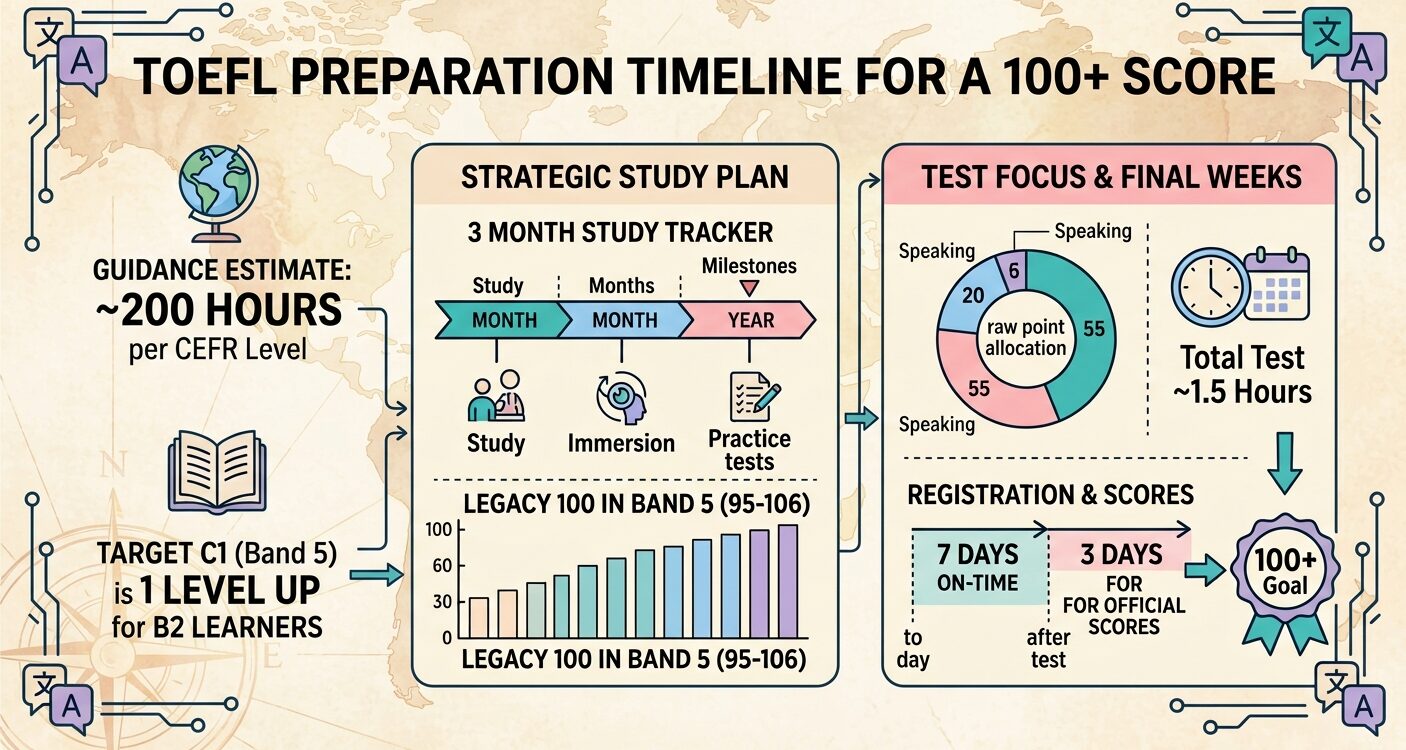
A legacy TOEFL total of 100 now falls inside band 5 on ETS’s 1–6 scale, and Cambridge English puts each CEFR step at about 200 guided learning hours. This TOEFL preparation timeline for a 100+ score lines those figures up against ETS’s January–December 2025 score data, the 2026 test blueprint, 2026–27 booking rules, and current Oxford and Stanford cutoffs.
TOEFL Preparation Timeline for a 100+ Score
How Many Study Hours Sit Between B2 and a TOEFL 100?
Cambridge English estimates about 200 guided learning hours to move up one CEFR level. Its cumulative guide puts B2 at 500–600 hours from beginner level and C1 at 700–800.
ETS aligns band 5, the new home of a legacy 100, with C1. A B2 learner sits one CEFR level below that target.
Four factors move the total, Cambridge says: language background, study intensity, age, and exposure outside lessons, such as at-home immersion routines. It labels its figures a guideline only.
ETS published its own three-month study plan for the 2026 test on its TOEFL blog on April 1, 2026.
Hour estimates also frame goals in other languages, such as the time English speakers need to reach B2.
Source: Cambridge English, Guided learning hours (page updated 14 October 2026); ETS score scale guide, 2026; ETS TOEFL blog, April 2026
Band 5 Replaced 100: The TOEFL 100+ Target Since 21 January 2026
| Band (1–6) | CEFR | Legacy total (0–120) | Reading | Listening | Writing | Speaking |
|---|---|---|---|---|---|---|
| 6 | C2 | 114+ | 29–30 | 28–30 | 29–30 | 28–30 |
| 5.5 | C1 | 107+ | 27–28 | 26–27 | 27–28 | 27 |
| 5 | C1 | 95+ | 24–26 | 22–25 | 24–26 | 25–26 |
| 4.5 | B2 | 86+ | 22–23 | 20–21 | 21–23 | 23–24 |
| 4 | B2 | 72+ | 18–21 | 17–19 | 17–20 | 20–22 |
Source: ETS, TOEFL Score Scale Update: A Guide for Institutions, scale in effect from 21 January 2026
ETS recommends band 5 for programs that required 100, with 5 in each section as well. Its concordance places band 5 across legacy totals of 95 through 106.
A 5.5 cutoff might admit fewer sub-100 applicants, ETS says, but it would raise the chance of rejecting qualified candidates who scored 100 or higher.
The overall band is the average of the four section bands, rounded to the nearest half band. A 5.125 average reports as 5; a 5.25 average reports as 5.5.
Until January 2028, score reports show three figures: CEFR level, 1–6 scores, and a comparable 0–120 total set at the band’s midpoint.
CEFR anchors other exams too, as LingoBright’s HSK-to-CEFR alignment data shows.
Section Gaps That Stretch a TOEFL Preparation Timeline for 100+
Speaking’s band-5 floor ranked highest of the four sections in 2025. A Speaking score of 25 placed at the 82nd percentile of all test takers; Reading 24 placed at the 51st.
| Section | Band-5 floor (legacy 0–30) | Percentile rank of floor, 2025 | 2025 mean (legacy 0–30) |
|---|---|---|---|
| Reading | 24 | 51 | 21.9 |
| Listening | 22 | 40 | 22.1 |
| Writing | 24 | 66 | 21.2 |
| Speaking | 25 | 82 | 20.6 |
Source: ETS, TOEFL iBT Test and Score Data Summary 2025, January–December 2025 test data, total group; floors from ETS score scale guide
Listening was the only section with a 2025 mean, 22.1, at or above its floor. The total mean was 86, and a total of 100 ranked at the 74th percentile.
Graduate applicants in 2025
Test takers applying to graduate programs outside business averaged 89, and a 100 ranked at their 70th percentile.
Speaking was their lowest section mean at 21.1, against 23.1 in Reading. For this group, Speaking 25 ranked at the 79th percentile and Reading 24 at the 45th.
Source: ETS, TOEFL iBT Test and Score Data Summary 2025, Table 6 (graduate level, non-business), January–December 2025
How Did Test Takers Score by Native Language in 2025?
Telugu speakers averaged 25 in Reading and 26 in Listening but 20 in Speaking. Vietnamese speakers averaged 23 in Reading and 13 in Speaking.
| Native language | Reading | Listening | Speaking | Writing | Total |
|---|---|---|---|---|---|
| Arabic | 18 | 20 | 20 | 19 | 77 |
| Chinese | 23 | 22 | 21 | 22 | 87 |
| Farsi | 23 | 24 | 21 | 23 | 91 |
| Hindi | 24 | 25 | 23 | 23 | 95 |
| Japanese | 19 | 19 | 17 | 18 | 73 |
| Korean | 22 | 22 | 20 | 22 | 86 |
| Spanish | 21 | 22 | 21 | 20 | 84 |
| Telugu | 25 | 26 | 20 | 21 | 92 |
| Vietnamese | 23 | 21 | 13 | 19 | 76 |
Source: ETS, TOEFL iBT Test and Score Data Summary 2025, Table 15, January–December 2025 (legacy 0–30 and 0–120 scales)
ETS reports these as rounded group means. It warns against ranking countries by them, since test takers do not represent all English speakers in a defined population.
As of October 2026, ETS’s site states that TOEFL and GRE testing within Iran is paused after a U.S. Treasury (OFAC) regulatory change. Iranian nationals may test outside Iran where testing is offered.
Source: ETS, TOEFL iBT score scale guide page notice, viewed October 2026
120 Items and 145 Raw Points: What the 2026 Test Measures
| Section | Items | Raw points | Task types | Estimated time |
|---|---|---|---|---|
| Reading | 50 | 35 | Complete the Words; Read in Daily Life; Read an Academic Passage | 18–21 min + 9 min module |
| Listening | 47 | 35 | Listen and Choose a Response; Listen to a Conversation; Listen to an Announcement; Listen to an Academic Talk | 18 min + 7 or 11 min module |
| Writing | 12 | 20 | Build a Sentence; Write an Email; Write for an Academic Discussion | 23 min |
| Speaking | 11 | 55 | Listen and Repeat; Take an Interview | 8 min |
Source: ETS, TOEFL iBT Test: 2026 Update, Test Blueprint and Specifications
ETS’s blueprint puts total test time at 1 hour 23 minutes to 1 hour 29 minutes. Item counts include non-scored Reading and Listening items.
Reading and Listening run as two-stage adaptive sections. Writing and Speaking are linear, with the same tasks for every test taker on a form.
Speaking carries 55 of the 145 raw points in about 8 minutes. Reported bands still weight sections equally, because the overall band is the average of the four section bands.
The 2026–27 Bulletin lists no scheduled breaks. ETS noted the blueprint could see minor revisions before launch.
Source: ETS 2026 Test Blueprint; ETS TOEFL iBT Information Bulletin 2026–2027
Booking Windows in the Final Weeks of a TOEFL 100+ Plan
Regular online registration closes 7 full days before the test. Express registration adds a fee and closes 2 days before.
Cancellations and reschedules need at least 4 full days’ notice. An on-time cancellation refunds 50% of the test fee.
Official scores post about 3 days after the test. Speaking and Writing reviews can be ordered for 30 days, and an unchanged result is confirmed within 3 weeks.
No cap applies to attempts, but ETS bars testing more than once in a 3-day period. Scores stay valid for 2 years, and MyBest combines the best section scores from valid tests in that span.
Accommodations must be approved before registration, and ETS’s document review takes about four to six weeks. For Australian visas, only tests taken before 21 January 2026 and TOEFL iBT Australia are approved, the Bulletin states.
Source: ETS, TOEFL iBT Information Bulletin 2026–2027, policies in effect July 2026–June 2027
Do Oxford and Stanford Accept 2026 Scores for a 100 Requirement?
University of Oxford
| Level | Overall | Listening | Reading | Speaking | Writing |
|---|---|---|---|---|---|
| Standard | 100 | 22 | 24 | 25 | 24 |
| Higher | 110 | 22 | 24 | 25 | 24 |
Source: University of Oxford, Graduate Application Guide: English language proficiency, viewed October 2026
Oxford’s standard-level section minimums equal ETS’s band-5 section floors. Oxford will not accept TOEFL tests taken from 21 January 2026 until a review of the revised test is complete.
Scores must come from a single test, so MyBest is not accepted. Oxford also advises that securing a test place can take several months.
Applicants just short of the standard level can enrol in a six-week online pre-sessional course with a TOEFL of 92 overall and 21 per component.
Oxford still accepts IELTS Academic, C1 Advanced, C2 Proficiency and the Oxford Test of English Advanced; LingoBright tracks IELTS test-taker volumes by country.
Stanford University
Stanford Graduate Admissions requires 4.5 for tests taken on or after 21 January 2026 and 90 for earlier tests. Exemption from its English Placement Test takes 5.5, or 109 on the legacy scale.
MyBest scores are accepted. For Autumn 2027–28 entry, applications opened in September 2026 and the earliest valid test date is September 1, 2024.
IELTS minimums are 7 and 8 for the same two thresholds; LingoBright compares IELTS band requirements at top US universities.
Stanford exempts U.S. citizens, permanent residents and holders of English-medium degrees. For enrollment context, see LingoBright’s international student statistics for the U.S.
Source: Stanford Graduate Admissions, Test Scores, Autumn 2027–28 cycle, viewed October 2026
FAQs
How long does it take to prepare for a TOEFL 100?
It depends on your starting level. Cambridge English estimates about 200 guided learning hours per CEFR level, and band 5, the 100-equivalent, aligns with C1. ETS’s own 2026 study plan runs three months.
What is 100 on the new TOEFL 1–6 scale?
Band 5. ETS places legacy totals of 95 to 106 in band 5, aligned with CEFR C1, and recommends 5 overall and in each section for programs that required 100.
Is 100 a good TOEFL score?
Yes, by 2025 data. A total of 100 ranked at the 74th percentile among all TOEFL iBT takers from January to December 2025, when the mean total was 86, according to ETS.
Is a one-month plan from Reddit enough for TOEFL 100?
Only if your practice scores already sit near band 5 in every section. Cambridge English puts one CEFR step at about 200 guided hours, and ETS’s 2026 study plan spans three months.
How soon can I retake the TOEFL?
ETS sets no limit on attempts but blocks testing more than once in a 3-day period, under its 2026–27 Bulletin. Official scores post about 3 days after each test.
Sources
https://www.ets.org/pdfs/toefl/toefl-ibt-test-score-data-summary-2025.pdf
https://www.ets.org/toefl/institutions/ibt/score-scale-update.html
https://www.eu.ets.org/pdfs/toefl/toefl-ibt-bulletin.pdf
https://support.cambridgeenglish.org/hc/en-gb/articles/202838506-Guided-learning-hours
