

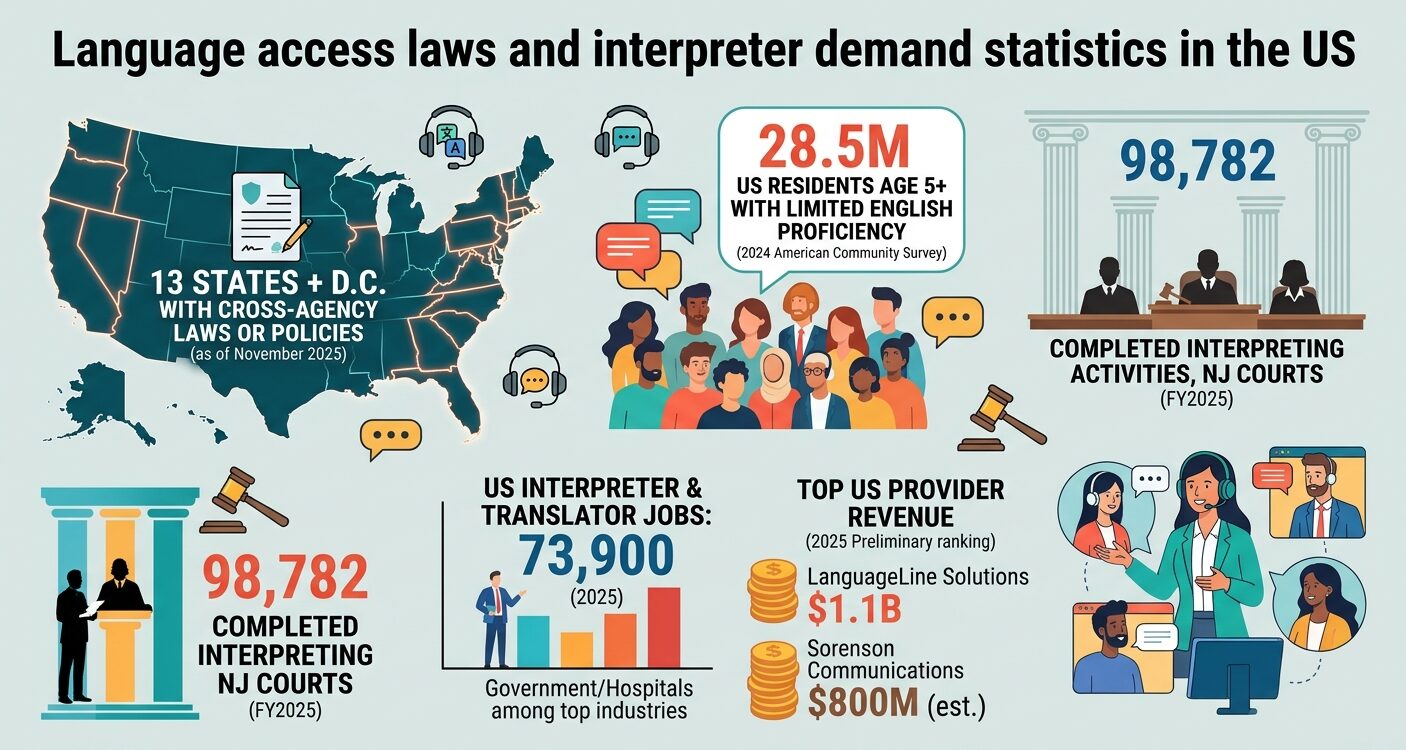
Thirteen states and the District of Columbia had cross-agency language access laws or policies as of November 2025, while 28.5 million US residents aged five and older had limited English proficiency in 2024. This brief sets language access laws beside interpreter demand data: state and local law counts, federal guidance rescissions, court interpreting volumes in New Jersey and New Mexico, BLS workforce figures and 2025 provider revenue.
Language Access Laws and Interpreter Demand in the US Statistics
Do Language Access Laws Reach the States With the Most LEP Residents?
KFF names eight states with relatively high shares of residents with limited English proficiency (LEP) in 2024. Six of them appear on the Migration Policy Institute’s November 2025 list of states with cross-agency language access laws or policies; Florida and Texas do not.
| State | Residents 5+ with LEP, 2024 |
|---|---|
| California | 18% |
| New York | 15% |
| New Jersey | 14% |
| Florida | 14% |
| Texas | 13% |
| Nevada | 12% |
| Hawaii | 11% |
| Massachusetts | 10% |
Source: KFF analysis of 2024 American Community Survey data, published September 2026
Shares run from under 1% in West Virginia to 18% in California. Four states hold 56% of all LEP residents: California (23%), Texas (13%), Florida (11%) and New York (9%).
Spanish is the primary language of 63% of people with LEP, followed by Chinese (7%), Vietnamese (3%), Tagalog (2%) and Arabic (2%).
Noncitizen immigrants report LEP at 59%, against 37% of naturalized citizens and 2% of US-born citizens. LingoBright’s refugee and immigrant language learning statistics cover the English-instruction side of that gap.
Source: KFF, 2024 American Community Survey data
Half (50%) of LEP adults who used health care said they hit at least one language barrier there over three years, in KFF’s 2023 Survey on Racism, Discrimination, and Health.
Source: KFF Survey on Racism, Discrimination, and Health, June to August 2023
Florida’s English-only driver license exams
Florida moved all driver license knowledge and skills exams to English only on February 6, 2026, covering every license class and oral exams. Translation services are no longer permitted during testing.
Knowledge exams for most non-commercial licenses had been offered in multiple languages, while commercial learner’s permit and CDL knowledge exams were offered in English and Spanish.
Source: Florida Department of Highway Safety and Motor Vehicles announcement, January 30, 2026
Language Access Laws by State: 13 States and D.C. as of November 2025
California’s Dymally-Alatorre Bilingual Services Act (1973) carries the earliest year in MPI’s state table. Delaware, Illinois, New Jersey and North Carolina each added a measure in 2024.
Bars run from the year each measure was enacted or majorly revised to MPI’s November 2025 mapping. Nine states and 31 localities enacted new cross-agency laws or policies since 2020.
Eleven states have formalized laws. At least 66 localities in 26 states have qualifying policies, and 44% of those local policies were enacted since 2020.
Source: Migration Policy Institute, New Frameworks for Language Access, mapping as of November 2025 (published January 2026)
Washington Governor Bob Ferguson signed SHB 2475 on March 23, 2026, after MPI’s cutoff. It directs the Office of Equity to set consistent language access guidelines for state agencies and propose a plan for the state’s interpreter and translator shortage.
Colorado passed a bill in May 2025 requiring an assessment of language access in state agencies before a formal policy; MPI will add Colorado once that policy exists.
Source: Washington State Office of Equity, March 2026; Migration Policy Institute, November 2025
What do state and local language access laws require?
| Policy feature | Share of analyzed laws and policies |
|---|---|
| Identification of affected agencies | More than 90% |
| Oral language assistance | About 85% |
| Translation of written and online materials | About 85% |
| Oversight office, entity or staff | Nearly 80% |
| Staff training, accuracy standards, public notice | More than 70% |
| Data and population tracking | Almost two-thirds |
| Language access coordinators and plans | Just under two-thirds |
| Funding provisions | About 40% |
| Community involvement | About 40% |
Source: MPI analysis of cross-agency state and local language access laws and policies, November 2025
Interpretation and translation duties each appear in about 85% of the policies MPI analyzed. Funding provisions appear in about 40%.
New Jersey Courts Logged 98,782 Interpreting Activities in FY2025
New Jersey courts, FY2016 to FY2025
New Jersey courts recorded 98,782 completed interpreting activities in FY2025 (July 2024 to June 2025), up from 81,549 in FY2024 and 75,464 in FY2023. The Judiciary attributes the FY2020 and FY2021 drops to the COVID-19 pandemic; FY2022 is not plotted.
FY2025 activity spanned 117 languages, against 114 a year earlier. Counts before FY2016 used “events,” a unit the Judiciary says is not comparable.
Source: New Jersey Judiciary, Court Interpreting Statistics, FY2016 to FY2025
| Language (source label) | Completed activities, FY2024 | Completed activities, FY2025 |
|---|---|---|
| Spanish | 68,963 | 82,150 |
| Portuguese | 1,923 | 2,878 |
| Haitian Creole | 1,613 | 2,799 |
| Arabic, Egyptian Colloquial | 1,175 | 1,524 |
| Chinese, Mandarin | 1,018 | 1,421 |
| American Sign Language (ASL) | 651 | 806 |
Source: New Jersey Judiciary, statewide completed activities by language, FY2024 and FY2025
Portuguese and Haitian Creole followed Spanish in both years. LingoBright’s heritage language speaker statistics cover US-born speakers of home languages like these.
Activities before judges rose from 60,644 to 66,172. “Any Court Support Service” activities, which involve probation officers, ombudsman and other Judiciary staff plus attorneys, sheriffs and volunteers, rose from 12,828 to 23,820.
Essex County reported 10,141 support service activities in FY2025, against 566 in FY2024; the release gives no reason for the change.
Source: New Jersey Judiciary, completed activities by court official, FY2024 and FY2025
New Mexico courts, FY2025
New Mexico courts provided interpreting in 87 languages in FY2025, and people requested about 50,300 interpreting hours, more than double FY2021. Spanish, American Sign Language, Navajo, Arabic and Vietnamese were the five most requested.
Full certification requires a written test, then an oral exam that mirrors courtroom speed. LingoBright compares language certification validity periods across other credentials.
About 20 fully certified Spanish interpreters and a dozen Justice System Interpreters work with the state courts. Most interpreters are contractors, and 13 are Judiciary staff.
Source: New Mexico Administrative Office of the Courts, February 25, 2026 release (FY2025 data)
What Changed in Federal Language Access Rules After Executive Order 14224?
| Date | Federal action | What it did |
|---|---|---|
| March 1, 2025 | Executive Order 14224 | Designated English the official language; revoked EO 13166 (2000) |
| July 14, 2025 | Attorney General memorandum | Rescinded DOJ language access guidance; promised further guidance for January 2026 |
| August 29, 2025 | Treasury rescission (notice published March 4, 2026) | Withdrew 2005 Treasury LEP guidance for aid recipients |
| July 14, 2026 | DHS notice, 91 FR 43108 | Withdrew 2011 DHS LEP guidance for aid recipients |
Source: Federal Register, Treasury notice (March 4, 2026) and DHS notice (July 14, 2026); Migration Policy Institute, January 2026
Executive Order 14224 also removed the requirement that federal agencies provide language access in programs they deliver directly, MPI notes. Treasury’s March 2026 notice still pointed to future Justice Department guidance.
These rescissions cover agency guidance, not hiring. LingoBright tracks the separate question of federal jobs requiring language skills.
KFF notes that HHS issued regulations ending disparate impact as a basis for Title VI claims. Section 1557 of the Affordable Care Act still requires covered health entities to provide meaningful access to people with LEP.
Source: Migration Policy Institute, January 2026; KFF, September 2026
Do federal aid recipients still have to provide language assistance?
Title VI still applies. The Treasury and DHS notices both state a continuing obligation to comply with Title VI, and Treasury’s notice adds that denying language assistance can be evidence of national origin or disability discrimination in certain circumstances.
Source: Federal Register, Treasury notice (March 4, 2026) and DHS notice (July 14, 2026)
US Interpreter Demand and Supply: Jobs, Pay and Provider Revenue
BLS counts 73,900 interpreter and translator jobs in 2025 and a median annual wage of 60,170inMay2025(28.93 an hour). Employment is projected to grow 2% from 2025 to 2035, adding 1,500 jobs.
About 6,000 openings are projected each year, mostly to replace workers who change occupations or leave the labor force. LingoBright’s certified bilingual job market data covers credentialed hiring outside interpreting.
Source: BLS Occupational Outlook Handbook, 2025 employment, May 2025 wages, 2025 to 2035 projections
| Employer (BLS label) | Share of interpreter and translator jobs, 2025 |
|---|---|
| Professional, scientific, and technical services | 30% |
| Self-employed workers | 28% |
| Educational services; state, local, and private | 15% |
| Hospitals; state, local, and private | 7% |
| Government, excluding state and local education and hospitals | 5% |
Source: BLS Occupational Outlook Handbook, largest employers of interpreters and translators, 2025
Government (excluding state and local education and hospitals) paid a median of $74,320, the highest of the industries BLS lists, and hospitals paid $63,000. Those wage figures exclude self-employed workers.
Source: BLS, median annual wages by industry, May 2025
Largest US interpreting providers by 2025 revenue
LanguageLine Solutions posted 1.1billionin2025revenueinNimdzi’spreliminary2026ranking,aheadofSorensonCommunications(800.0 million, a Nimdzi estimate) and Propio Language Services ($566.5 million). The chart covers US companies whose Nimdzi business listing begins with interpreting.
Interpreting, human and machine combined, made up 19.3% of Nimdzi survey respondents’ total revenue.
Source: Nimdzi, Preliminary 2026 Nimdzi 100 ranking, 2025 revenue (March 2026)
AI interpreting and the five-minute wait
Delays in care were the top consequence of an unavailable interpreter, named by 60% of respondents in a Boostlingo and Fierce Healthcare survey of 123 healthcare respondents fielded April 6 to May 6, 2026.
About 1 in 5 would use AI interpreting immediately; about 3 in 4 would consider it once a human interpreter wait passes five minutes. Boostlingo, an interpreting technology vendor, calls the results directional, not representative.
Source: Boostlingo and Fierce Healthcare, AI Interpreting in Healthcare 2026, survey April to May 2026
FAQs
How many people in the US have limited English proficiency?
About 28.5 million people aged five and older, or 9% of that age group, had limited English proficiency in 2024, based on KFF’s analysis of American Community Survey data. California held 23% of them.
How many states have language access laws?
Thirteen states and the District of Columbia had cross-agency language access laws or policies as of November 2025, per the Migration Policy Institute. Eleven had formalized laws. Washington signed SHB 2475 in March 2026.
Is language access still required after English became the official language?
For federal aid recipients, yes. Executive Order 14224 revoked EO 13166, but Title VI still applies, and DHS’s July 14, 2026 notice says recipients keep a continuing obligation to comply with it.
Which languages need court interpreters most?
In state court data, Spanish leads by a wide margin. New Jersey logged 82,150 Spanish completed activities in FY2025, then Portuguese (2,878) and Haitian Creole (2,799). New Mexico’s top five were Spanish, ASL, Navajo, Arabic and Vietnamese.
Reddit threads aside, is interpreter employment growing?
Slowly. BLS projects interpreter and translator jobs to grow 2% from 2025 to 2035, adding 1,500 positions. About 6,000 openings a year are expected, mostly replacing workers who leave the occupation.
