

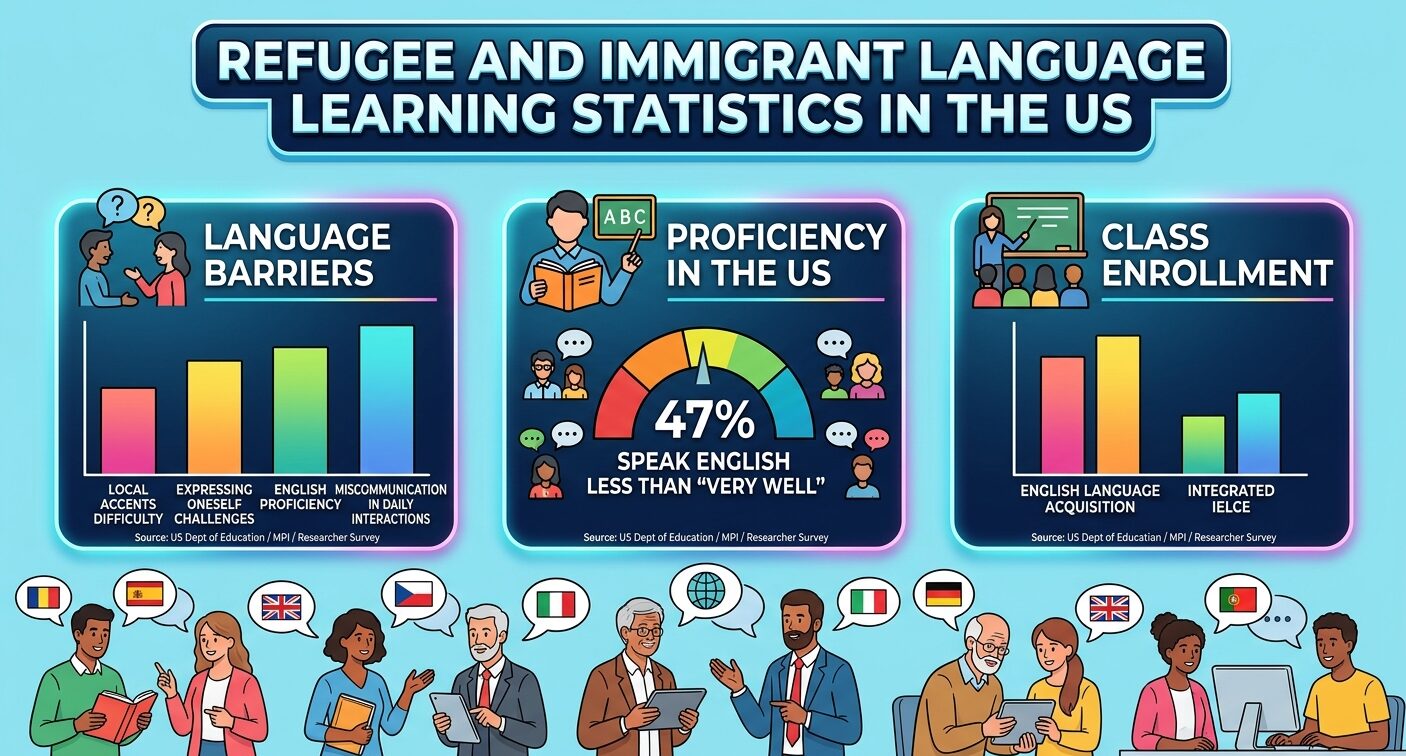
Federally funded English Language Acquisition programs enrolled 443,689 participants in program year 2023-24, while 23.5 million immigrants reported speaking English less than “very well” in 2024. These refugee and immigrant language learning statistics in the US cover class enrollment, English proficiency, refugee arrivals through FY2026, survey-reported barriers, and the funding and court decisions affecting adult ESL in 2025 and 2026.
Refugee and Immigrant Language Learning Statistics in the US
How Many Adults Take Federally Funded English Classes in the US?
Programs funded under the Adult Education and Family Literacy Act reported 1,261,601 participants in program year 2023-24. NRS rules count Integrated English Literacy and Civics Education participants only under that program type, so the two English rows do not overlap.
| Program type | PY2022-23 participants | PY2023-24 participants |
|---|---|---|
| Adult Basic Education | 394,449 | 419,654 |
| Adult Secondary Education | 84,375 | 90,108 |
| English Language Acquisition | 434,896 | 443,689 |
| Integrated English Literacy and Civics Education (Sec. 243) | 178,707 | 308,150 |
| Total | 1,092,427 | 1,261,601 |
Source: U.S. Department of Education, National Reporting System for Adult Education, Table 3 (aggregate), program years 2022-23 and 2023-24
Integrated English Literacy and Civics Education rose from 178,707 to 308,150 participants between the two program years. English Language Acquisition moved from 434,896 to 443,689.
Adults ages 25 to 44 accounted for 253,538 of the 443,689 English Language Acquisition participants. The NRS age brackets differ in width, from three years (16–18) to 20 years (25–44).
Adult Basic Education, which teaches basic skills below the secondary level, enrolled 419,654 participants. Global context sits in LingoBright’s adult literacy rate trends across regions.
What Share of Adult English Learners Make Measurable Skill Gains?
The share of English literacy participants achieving a measurable skill gain reached 44.4% in the 2024 reporting year, which covers July 2023 to June 2024. The Education Department attributes the 2024 increase to a June 2024 change in how gains are counted.
Source: U.S. Department of Education, FY2026 Budget Request, Career, Technical, and Adult Education, reporting years 2021–2024
Immigrant English Proficiency: 23.5 Million Speak English Less Than “Very Well”
Immigrants ages 5 and older numbered 49.8 million in 2024, and 47% of them (23.5 million) spoke English less than “very well.” They made up about 81% of the 28.9 million US residents with limited English proficiency.
Source: Migration Policy Institute, Frequently Requested Statistics (March 12, 2026), 2024 American Community Survey
The 2024 survey is still the newest national release as of October 21, 2026. The Census Bureau has scheduled 2025 ACS 1-year estimates for October 29, 2026, after an August notice said it was assessing a new Commerce Department disclosure-avoidance order.
Source: U.S. Census Bureau, ACS update (August 6, 2026) and release notice CB26-164 (October 13, 2026)
Which Languages Do US Residents Speak at Home Besides English?
| Language | Speakers ages 5+, 2024 | Share of all speakers of foreign languages |
|---|---|---|
| Spanish | 44,811,000 | 61.4% |
| Chinese | 3,748,000 | 5.1% |
| Tagalog | 1,947,000 | 2.7% |
| Vietnamese | 1,604,000 | 2.2% |
| Arabic | 1,501,000 | 2.1% |
| French | 1,261,000 | 1.7% |
| Korean | 1,140,000 | 1.6% |
| Portuguese | 1,114,000 | 1.5% |
| Hindi | 1,073,000 | 1.5% |
| Haitian Creole | 1,035,000 | 1.4% |
| Total | 73,040,000 | 100.0% |
Source: Migration Policy Institute analysis of 2024 ACS data (IPUMS USA); Chinese includes Mandarin and Cantonese, French includes Cajun, Portuguese includes Cape Verdean Creole, Tagalog includes Filipino
The table counts every resident age 5 and older who speaks another language at home, born abroad or in the US. About 77% of the 321.7 million residents in that age group spoke only English.
Spanish was the most common home language after English in all but four states in pooled 2020-24 data: Alaska, Hawaii, Maine, and Vermont. LingoBright maps bilingualism rates by US state in more detail.
About 18.3 million US children lived with at least one immigrant parent in 2024, and 85% of them were US-born. Language use in that group overlaps with heritage language speaker statistics.
Source: Migration Policy Institute, 2024 ACS and pooled 2020-24 ACS
What Language Barriers Did Afghan Refugees and Migrants Report in Their First US Year?
A survey by Hiroshima University–affiliated researchers asked Afghan refugees and migrants about their first year in the US. Fieldwork ran January to October 2024, with respondents reached through resettlement agencies, community groups, and diaspora networks, so results describe that sample only.
| Survey statement | Share who agreed |
|---|---|
| I had difficulty in understanding local accents | 54% |
| I faced challenges in expressing oneself effectively | 50% |
| I was proficient in English | 45% |
| I experienced miscommunication in daily interactions | 40% |
Source: NERPS and CEPEAS, Hiroshima University, A Survey of Afghan Immigrants in the United States (2025), fieldwork January–October 2024, 216–217 respondents per statement
More respondents struggled with local accents (54%) than called themselves proficient (45%).
Language classes drew a 61% effective rating, against 51% for apps and other resources. Usage patterns for those tools appear in LingoBright’s language learning app downloads by US region.
Interpreter help scored 52%. That support depends on bilingual staff, a labor pool covered in job market demand for certified bilingual workers.
Source: NERPS and CEPEAS (2025), 140–155 respondents per strategy
US Refugee Admissions by Fiscal Year and Country of Origin
| Fiscal year | Refugees admitted | Admissions ceiling |
|---|---|---|
| FY2024 | 100,034 | 125,000 |
| FY2025 | 38,102 | 125,000 |
| FY2026 | 16,292 | 7,500, raised to 17,500 in May 2026 |
| FY2027 | Year began October 1, 2026 | 17,500 |
Source: State Department Refugee Processing Center data compiled by Pew Research Center (FY2024–FY2025); Refugee Processing Center arrivals report as of September 30, 2026 (FY2026); Presidential Determinations 2026-14 and 2026-24 (ceilings)
MPI describes the initial FY2026 ceiling of 7,500 as the lowest in the program’s history. An emergency determination dated May 21, 2026 raised it by 10,000, with the added slots allocated to Afrikaners from South Africa.
Monthly FY2026 arrivals ranged from 125 in November 2025 to 3,388 in September 2026. The State Department report shows no October 2025 column.
Source: U.S. State Department, Refugee Processing Center, Refugee Arrivals by State and Nationality, FY2026 (data as of October 5, 2026)
Origins shifted between the two years. MPI’s rounded FY2025 tabulation lists Afghanistan (6,800), the Democratic Republic of the Congo (5,700), Venezuela (4,600), Syria (4,600), and Burma (3,600) as the top five.
For FY2026, Axios counted 16,287 arrivals from South Africa and five from Afghanistan. The FY2027 determination, signed September 25, 2026, keeps the ceiling at 17,500 and states that admissions “shall primarily be allocated among Afrikaners from South Africa.”
Source: Migration Policy Institute (FY2025 data, March 2026); Axios (October 16, 2026); Federal Register, October 2, 2026
Funding for Refugee and Immigrant English Programs: $729.2 Million in FY2026
Congress set FY2026 adult education funding at $729.2 million and Title III English Language Acquisition grants at $890 million. The administration’s FY2026 request had proposed $0 for adult education state grants and national leadership, a line funded at $729,167,000 in FY2024.
Source: TESOL International Association (FY2026 enacted levels); U.S. Department of Education FY2026 budget request
FY2027 opened under a continuing resolution that funds Labor-HHS-Education programs at the FY2026 rate through December 11, 2026, per the Congressional Research Service. The House Appropriations Committee approved its FY2027 bill 34–28 on June 9, 2026; the Joint National Committee for Languages reports it would eliminate Title III’s $890 million.
Source: Congressional Research Service R49344 (September 8, 2026); House Appropriations Committee (June 9, 2026); JNCL-NCLIS (June 2026)
FY2024 adult education state grants totaled $715.455 million: $629.6 million for adult basic and literacy education and $85.855 million for Integrated English Literacy and Civics Education. The statute sets that 88% to 12% split, and the Department allocates 65% of civics funds by each state’s 10-year average of new legal permanent residents.
Source: U.S. Department of Education, FY2026 budget request, FY2024 output measures
What Happened to Local ESL Classes After Refugee Office Cuts?
Wisconsin Literacy’s funding fell from $2,857,703 in 2025 to $737,890 in 2026, which Wisconsin Watch tied to federal cuts at the Office of Refugee Resettlement. Grantee Literacy Green Bay cut ESL classes from 15 to eight, ended child care, and reported a 300-person waitlist.
Source: Wisconsin Watch, September 2026
Madison’s Literacy Network expected to lose $200,000 in yearly federal funding for its refugee program at the end of July 2026. That followed a $90,000 cut to its citizenship test program in 2025.
Source: WMTV, June 19, 2026
Policy Changes Shaping Refugee and Immigrant Language Learning, 2025–2026
| Date | Change | Source |
|---|---|---|
| Mar 1, 2025 | English designated the official US language | Executive Order 14224 |
| May 5, 2025 | Refugee cash and medical assistance cut from 12 to 4 months for newly eligible refugees | ORR Dear Colleague Letter 25-13 |
| Jul 11, 2025 | Adult education classified as a PRWORA “Federal public benefit” requiring status verification | Federal Register |
| Sep 10, 2025 | Notices blocked for 20 states and DC | U.S. District Court, D. Rhode Island |
| Oct 20, 2025 | 2025 civics test (20 questions from 128, 12 correct to pass) applies to new N-400s; English portions unchanged | USCIS |
| Sep 21, 2026 | ED, HHS, DOL, and HUD PRWORA notices vacated; enforcement against plaintiff states barred | U.S. District Court, D. Rhode Island |
Source: Agency notices, court orders, and Federal Register documents named in each row, March 2025–September 2026
The September 21, 2026 order found the Education Department notice procedurally invalid because it skipped notice-and-comment rulemaking. Agencies can still issue new rules after that process.
Source: U.S. District Court for the District of Rhode Island, New York v. U.S. Department of Justice, No. 1:25-cv-00345, September 21, 2026
The Education Department’s NRS website states it was reviewed for compliance with Executive Order 14224 and that some content was modified or archived. Language requirements in federal hiring are tracked in LingoBright’s count of federal jobs requiring language skills.
Source: National Reporting System for Adult Education website, accessed October 2026
How Long Does Refugee Cash Assistance Last Now?
Refugees whose ORR eligibility began on or after May 5, 2025 get up to four months of Refugee Cash Assistance and Refugee Medical Assistance, down from 12. ORR said the change was needed to avoid a significant budget shortfall; it had raised the period from eight to 12 months in FY2022.
Source: Office of Refugee Resettlement, Dear Colleague Letter 25-13, March 28, 2025
FAQs
How many immigrants in the US speak limited English?
About 23.5 million immigrants ages 5 and older, or 47%, spoke English less than “very well” in 2024. They accounted for about 81% of the 28.9 million US residents with limited English proficiency.
How many refugees did the US admit in 2026?
The US admitted 16,292 refugees in FY2026, which ran from October 1, 2025 to September 30, 2026. Axios counted 16,287 of them from South Africa. The FY2027 ceiling is 17,500.
Is federal funding for immigrant ESL classes being cut?
Federal adult education held at $729.2 million and Title III at $890 million for FY2026, and a stopgap keeps that rate through December 11, 2026. A House FY2027 committee bill would eliminate Title III.
Do immigrants need to pass an English test to become US citizens?
Yes, most applicants must show they can read, write, and speak basic English. USCIS left those portions unchanged in 2025; the civics test for N-400s filed from October 20, 2025 asks up to 20 questions.
Are Reddit posts about long ESL class waitlists accurate?
Reddit posts are anecdotes, but local reporting confirms some waitlists. Wisconsin Watch reported in September 2026 that Literacy Green Bay cut ESL classes from 15 to eight and had a 300-person waitlist.
Sources
https://nrs.ed.gov/rt/reports/aggregate/2023/all/table-3
