

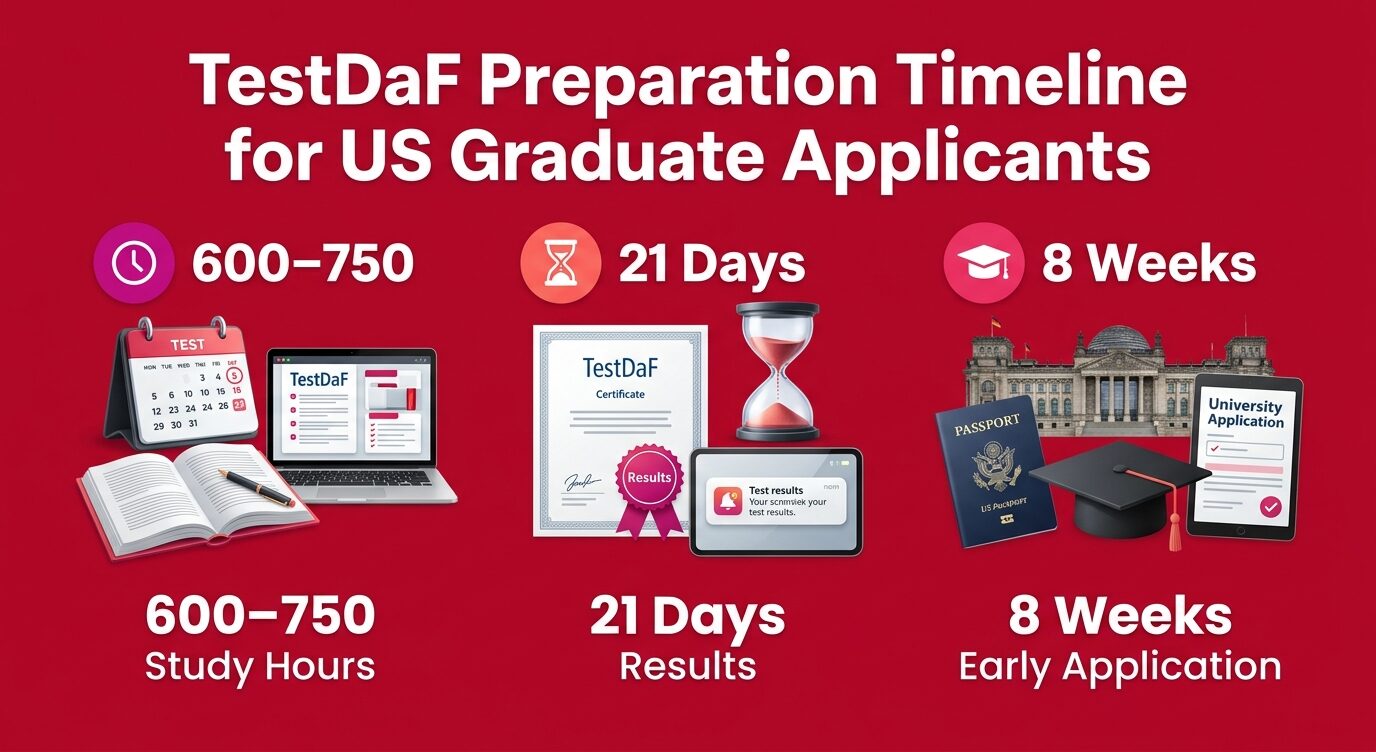
Only 1,944 of the 10,659 postgraduate programmes listed by German universities for winter semester 2025/26 taught mainly in English. For most US graduate applicants, that puts a German test score on the critical path. This TestDaF preparation timeline lines up the 2026 test calendar, result turnaround, uni-assist processing and Goethe-Institut study-hour estimates, including the dates still open as of November 2026.
TestDaF Preparation Timeline for US Graduate Applicants
When to Sit the TestDaF: Timeline for July 15 and January 15 Deadlines
The TestDaF-Institut sets test dates centrally, and each licensed centre runs its own subset of them. The 2026 calendar had 12 sittings: 8 digital and 4 paper-based.
Every digital sitting through November posted results online 21 days after test day. Paper sittings took 42 days, and the December 10 digital sitting is listed for January 6, 2027, which is 27 days out.
Source: Goethe-Institut Alexandria, TestDaF calendar 2026
| Intake | Common deadline | 8 weeks before | Last sitting with results by 8-week point | Last sitting with results by deadline |
|---|---|---|---|---|
| Winter 2026/27 | Jul 15, 2026 | May 20, 2026 | Apr 21 (results May 12) | Jun 11 (results Jul 2) |
| Summer 2027 | Jan 15, 2027 | Nov 20, 2026 | Sep 22 (results Oct 13) | Dec 10 (results Jan 6, 2027) |
Source: uni-assist, deadlines and 8-week recommendation (accessed November 2026); Goethe-Institut Alexandria, TestDaF calendar 2026. The 8-week dates are counted back from each deadline.
Four 2026 sittings returned results before May 20, and six before July 15. The June 11 results arrived 13 days before the July 15 deadline.
What Is Still Open for Summer 2027 Applicants?
Registration for the November 12 digital sitting closed on October 30, 2026. The December 10 digital sitting takes registrations until November 27, 2026.
Goethe-Institut Alexandria lists December 10 results for January 6, 2027, while BTU Cottbus-Senftenberg lists January 7, 2027. Both dates fall after November 20, the point 8 weeks before a January 15 deadline.
Source: Goethe-Institut Alexandria and BTU Cottbus-Senftenberg TestDaF pages, 2026 calendar
uni-assist Adds 4 to 6 Weeks to the TestDaF Preparation Timeline
uni-assist usually returns an evaluation result in 4 to 6 weeks, counted from the day it receives both the application and the payment. It recommends submitting documents and fees at least 8 weeks before the deadline.
July 15 is a common deadline for winter-semester courses and January 15 for summer-semester courses. Many universities set earlier deadlines for master’s courses.
Source: uni-assist, Deadlines and processing time (accessed November 2026)
About 8,400 more people applied through uni-assist in 2025 than in 2024. Applicant numbers grew 28.4% between 2023 and 2025.
| Country of origin | uni-assist applicants, 2025 (approx.) |
|---|---|
| India | 26,200 |
| Turkey | 12,500 |
| Pakistan | 10,000 |
| Iran | 7,300 |
| China | 5,200 |
Source: Wissenschaft weltoffen 2026 (DAAD and DZHW), uni-assist applicant data, 2025
How Many Study Hours Does TDN 4 Take? Goethe-Institut B1 to C1 Estimates
TestDaF covers CEFR levels B2 to C1. TDN 4 in all four sections serves as evidence of the German needed for admission to almost any subject and degree course.
Source: Goethe-Institut, TestDaF exam page (Dresden), accessed November 2026
| CEFR level | Hours of instruction | 45-minute teaching units |
|---|---|---|
| B1 | 260-490 | 350-650 |
| B2 | 450-600 | 600-800 |
| C1 | 600-750 | 800-1,000 |
Source: Goethe-Institut London, course FAQ estimates, accessed November 2026
The C1 band starts at 600 hours, where the B2 band ends. TestDaF reports a separate TDN 3, 4 or 5 for each skill rather than one total score.
Source: TestDaF exam regulations, October 2020 edition
Hour benchmarks differ by language, and this breakdown of time to reach B2 for English speakers puts German beside other major languages.
The same hours-first planning method appears in LingoBright’s TOEFL preparation timeline for a 100+ score.
Other admission exams on the CEFR scale use level-based plans too, as in this DELF B2 study plan and resource list.
For reading between classes, LingoBright publishes German content written for learners.
Only 18.2% of German Postgraduate Programmes Teach in English
HRK counted 1,944 programmes taught mainly in English among 10,659 postgraduate offerings for winter semester 2025/26. Postgraduate here covers all master’s programmes plus other further-degree courses.
| Programme group | Total | Taught mainly in English | English share |
|---|---|---|---|
| Postgraduate | 10,659 | 1,944 | 18.2% |
| Undergraduate | 11,767 | 439 | 3.7% |
| All programmes | 22,426 | 2,383 | 10.6% |
Source: HRK, Statistische Daten zu Studienangeboten, winter semester 2025/26 (Hochschulkompass, September 1, 2025)
English-Taught Postgraduate Programmes, 2018/19 to 2025/26
The count rose every winter semester, from 1,178 in 2018/19 to 1,944 in 2025/26. Total postgraduate offerings moved from 9,258 to 10,659 over the same period.
Source: HRK, Statistische Daten zu Studienangeboten, winter semester 2025/26
A later Hochschulkompass snapshot from May 2026 counted 2,507 English-taught programmes, 2,032 of them master’s. That count uses a different date and category, so it does not line up with the HRK table above.
Source: Wissenschaft weltoffen 2026 (DAAD and DZHW), HRK Hochschulkompass data, May 2026
Of 10,492 master’s programmes, 6,992 (66.6%) had no admission restriction in winter semester 2025/26.
Source: HRK, Statistische Daten zu Studienangeboten, winter semester 2025/26
US Graduate Applicants in Germany’s International Student Data
Germany enrolled 426,179 international students in winter semester 2025/26, up 6% on the previous year. They made up 14.8% of all students.
| Winter semester | International students | From the US |
|---|---|---|
| 2023/24 | 379,939 | 5,432 |
| 2024/25 | 402,083 | 5,330 |
| 2025/26 | 426,179 | Not in published summary |
Source: Wissenschaft weltoffen kompakt 2025 and 2026; Wissenschaft weltoffen 2026 (Federal Statistical Office student statistics)
US students held a 1.3% share in winter semester 2024/25, the 20th-largest origin country. North America was the only origin region with fewer students than five years earlier, down 12% between winter semesters 2019/20 and 2024/25.
Master’s study dominates the wider pool. In winter 2024/25, 187,907 international students (46.7%) were working toward a master’s, and international students made up 28.3% of all master’s students in Germany.
Source: Wissenschaft weltoffen kompakt 2026; Wissenschaft weltoffen 2026
International first-year students starting a master’s reached 53,794 in 2024, or 41.5% of 129,698 newcomers. The 2014 master’s figure was 23,467.
Source: Wissenschaft weltoffen kompakt 2026, international first-year students by degree, 2014, 2019 and 2024
Credit-bearing study abroad is a separate flow. Open Doors counted 9,682 US students studying in Germany for credit in 2023/24, the 7th-largest US destination, against 12,029 in 2018/19.
Source: Open Doors Germany Fact Sheet 2025 (IIE)
Germany ranked fourth among host countries in 2023 with 423,197 international students, while the US led with 956,923. LingoBright tracks the US side of international enrolment.
Source: Wissenschaft weltoffen 2026, UNESCO/OECD student statistics, 2023
Does a TestDaF Certificate Expire Before You Apply?
TestDaF exam regulations allow the test to be repeated any number of times. Licensed centres such as the University of Regensburg state that the certificate does not expire.
Universities can still apply their own age limits. The University of Hamburg’s bonus-point rules count language certificates only if they are no more than three years old on the first day of the application phase (June 1 for winter, December 1 for summer).
Source: TestDaF exam regulations, October 2020 edition; University of Regensburg TestDaF page; University of Hamburg bonus-point guidance
Other language certificates carry different validity periods, covered in LingoBright’s comparison of certificate validity and renewal rules.
FAQs
How long does it take to prepare for the TestDaF?
The Goethe-Institut estimates 450-600 hours of instruction to complete B2 and 600-750 hours for C1. TestDaF measures German across the B2 and C1 levels.
How long does it take to get TestDaF results?
Digital results went online 21 days after the test on 2026 dates, except December 10 at 27 days. Paper results took 42 days, according to the Goethe-Institut Alexandria calendar.
Which TestDaF dates are left before January 15, 2027?
Only the December 10, 2026 digital sitting remains open. Registration closes November 27. Results are listed for January 6, 2027 (Goethe-Institut Alexandria) or January 7 (BTU Cottbus-Senftenberg).
Is TDN 4 enough for a master’s degree in Germany?
TDN 4 in all four sections counts as language evidence for almost any subject and degree course, per the Goethe-Institut. Check each programme’s admission page for its stated requirement.
Are Reddit estimates of TestDaF study time reliable?
Forum posts reflect individual learners. The published benchmark is the Goethe-Institut’s 450-600 instruction hours for B2 and 600-750 for C1.
Sources
- https://www.hrk.de/fileadmin/redaktion/hrk/02-Dokumente/02-03-Studium/02-03-01-Studium-Studienreform/HRK_Statistik_BA_MA_UEbrige_WiSe_2025_26.pdf
- https://www.goethe.de/ins/eg/de/sta/alx/prf/testdaf.html
- https://www.wissenschaft-weltoffen.de/content/uploads/2026/10/WWO_2026_web.pdf
- https://uni-assist.de/en/how-to-apply/plan-your-application/deadlines-processing-time
- https://www.lingobright.com/statistics/testdaf-exam-structure-and-scoring-for-us-applicants-to-german-universities/
